Application
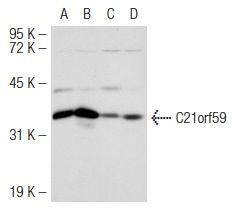
Western blot analysis of C21orf59 expression in HeLa (A), K-562 (B), PC-3 (C) and LNCaP (D) whole cell lysates.| Product Name | C21orf59 Antibody (L-20) |
|---|---|
| Antibody Type | Primary Antibodies |
| Modification Notes | The smallest of the human chromosomes, 21 makes up about 1.5% of the human genome. Chromosome 21 contains nearly 300 genes and 47 million base pairs. Down syndrome, also known as trisomy 21, is the disease most commonly associated with chromosome 21. Alzheimer's disease, Jervell and Lange-Nielsen syndrome and amyotrophic lateral sclerosis are also associated with chromosome 21. Translocations are found to occur between chromosome 21 and 8, and chromosome 21 and 12, in certain leukemias. C21orf59, also known as C21orf48, is a 290 amino acid protein and its gene product has been provisionally designated C21orf59 pending further characterization. |
| Clonality | Polyclonal |
|---|---|
| Isotype | IgG |
| Host Species | Rabbit |
| Tested Applications | WBIPIFELISA |
| recommended for detection of C21orf59 of human origin by WB, IP, IF and ELISA also reactive with additional species, including equine, canine, bovine and porcine | |
| Species Reactivity | HumanMouseRat |
| Concentration | 1mg/ml |
| Purification | Affinity purified |
| Alternative Names | epitope mapping within an internal region of C21orf59 of human origin |
|---|---|
| Tissue Specificity | epitope mapping within an internal region of C21orf59 of human origin |
| Entrez Gene | 56683 |
|---|
Application
Western blot analysis of C21orf59 expression in HeLa (A), K-562 (B), PC-3 (C) and LNCaP (D) whole cell lysates.| Application Notes | recommended for detection of C21orf59 of human origin by WB, IP, IF and ELISA also reactive with additional species, including equine, canine, bovine and porcine |
|---|
| Form | Liquid |
|---|---|
| Storage Instructions | For short-term storage, store at 4° C. For long-term storage, aliquot and store at -20ºC or below. Avoid multiple freeze-thaw cycles. |
| Storage Buffer | phosphate buffered saline , pH 7.4, 150mM NaCl, 0.02% sodium azide and 50% glycerol. |


