Application
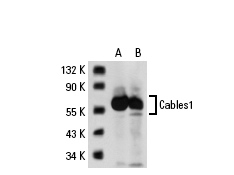
Western blot analysis of Cables1 expression in mouse heart (A) and rat heart (B) tissue extracts.| Product Name | Cables1 Antibody (M-280) |
|---|---|
| Antibody Type | Primary Antibodies |
| Modification Notes | Normal Abl function is essential for humans because Philadelphia chromosome translocation involving the ABL gene causes chronic myelogenous leu-kemia. Abl associates with a broad range of targets and appears to function in various signaling pathway. Cables1, a 568 amino acid protein, links Abl to cyclin-dependent kinase 5 (Cdk5). Cables1 bound to Cdk5 functions as a substrate for phosphorylation by the Cdk5/p35 kinase. Cables contains an area of weak homology to cyclin A and cyclin C. In addition to its C-terminal Cdk5 binding domain, Cables1 also has six potential SH3 binding motifs (PXXP) clustered around the amino-terminus, two of which are similar to motifs known to bind the Abl SH3 domain. Cables1 forms a trimolecular complex with Cdk5 and Abl in vivo. All three proteins co-localize within cortical axons, particularly in their growth cones. Cables1 and Abl may function as adaptor or scaffolding proteins to bind to Cdk5 and control its subcellular location in the neuron. |
| Clonality | Polyclonal |
|---|---|
| Isotype | IgG |
| Host Species | Rabbit |
| Tested Applications | WBIPIFELISA |
| recommended for detection of Cables1 of mouse, rat and human origin by WB, IP, IF and ELISA | |
| Species Reactivity | HumanMouseRat |
| Concentration | 1mg/ml |
| Purification | Affinity purified |
| Alternative Names | epitope corresponding to amino acids 1-280 mapping at the N-terminus of Cables1 of mouse origin |
|---|---|
| Tissue Specificity | epitope corresponding to amino acids 1-280 mapping at the N-terminus of Cables1 of mouse origin |
| Entrez Gene | 63955 |
|---|
Application
Western blot analysis of Cables1 expression in mouse heart (A) and rat heart (B) tissue extracts.| Application Notes | recommended for detection of Cables1 of mouse, rat and human origin by WB, IP, IF and ELISA |
|---|
| Form | Liquid |
|---|---|
| Storage Instructions | For short-term storage, store at 4° C. For long-term storage, aliquot and store at -20ºC or below. Avoid multiple freeze-thaw cycles. |
| Storage Buffer | phosphate buffered saline , pH 7.4, 150mM NaCl, 0.02% sodium azide and 50% glycerol. |


