Application
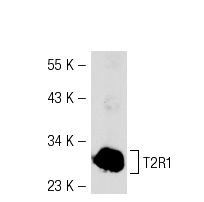
Western blot analysis of T2R1 expression in rat small intestine tissue extract.| Product Name | T2R1 Antibody (M-56) |
|---|---|
| Antibody Type | Primary Antibodies |
| Modification Notes | The sense of taste is essential for the survival of organisms. For example, the ability to identify sweet-tasting foods enables animals to seek out food with high nutritive value, whereas the ability to identify bitter substances enables them to avoid the ingestion of potentially harmful substances. A family of integral membrane proteins are involved in taste perception and include T1R, which is involved in sweet taste perception and T2R, which is involved in bitter taste perception. Both types of taste receptors couple to various G proteins to initiate signal transduction cascades. Specifically, T2R1 is expressed in subsets of taste receptor cells of the tongue and palate epithelium and exclusively in gustducin-positive cells. |
| Clonality | Polyclonal |
|---|---|
| Isotype | IgG |
| Host Species | Rabbit |
| Tested Applications | WBIPIFELISA |
| recommended for detection of T2R1 of mouse and, to a lesser extent, rat origin by WB, IP, IF and ELISA | |
| Species Reactivity | HumanMouseRat |
| Concentration | 1mg/ml |
| Purification | Affinity purified |
| Alternative Names | epitope corresponding to amino acids 121-176 mapping within an internal region of T2R1 of mouse origin |
|---|---|
| Tissue Specificity | epitope corresponding to amino acids 121-176 mapping within an internal region of T2R1 of mouse origin |
| Entrez Gene | 50834 |
|---|
Application
Western blot analysis of T2R1 expression in rat small intestine tissue extract.| Application Notes | recommended for detection of T2R1 of mouse and, to a lesser extent, rat origin by WB, IP, IF and ELISA |
|---|
| Form | Liquid |
|---|---|
| Storage Instructions | For short-term storage, store at 4° C. For long-term storage, aliquot and store at -20ºC or below. Avoid multiple freeze-thaw cycles. |
| Storage Buffer | phosphate buffered saline , pH 7.4, 150mM NaCl, 0.02% sodium azide and 50% glycerol. |


