Application
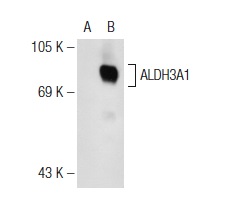
Western blot analysis of ALDH3A1 expression in non-transfected: (A) and human ALDH3A1 transfected: (B) 293 whole cell lysates.Application
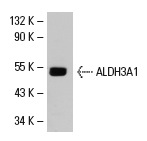
Western blot analysis of ALDH3A1 expression in A549 whole cell lysate.| Product Name | ALDH3A1 Antibody (H-76) |
|---|---|
| Antibody Type | Primary Antibodies |
| Modification Notes | Aldehyde dehydrogenases (ALDHs) mediate NADP+-dependent oxidation of aldehydes into acids, the metabolism of corticosteroids, biogenic amines and neurotransmitters, and lipid peroxidation. ALDH1A1, also designated retinal dehydrogenase 1 (RalDH1 or RALDH1), aldehyde dehydrogenase family 1 member A1, aldehyde dehydrogenase cytosolic, ALDHII, ALDH-E1 or ALDH E1, is a retinal dehydrogenase that participates in the biosynthesis of retinoic acid (RA). There are two major liver isoforms of ALDH1 that can localize to cytosolic or mitochondrial space. The ALDH1A2 (RALDH2, RALDH2-T) gene produces three different transcripts and also catalyzes the synthesis of RA from retinaldehyde. ALDH1A3 (ALDH6, RALDH3, ALDH1A6) is a 37 kb gene that consists of 13 exons and produces a major transcript of approximately 3.5 kb most abundant in salivary gland, stomach and kidney. ALDH3A1 (stomach type, ALDH3, ALDHIII) forms a cytoplasmic homodimer that preferentially oxidizes aromatic aldehyde substrates. ALDH genes upregulate as a part of the oxidative stress response and appear to be abundant in certain tumors that have an accelerated metabolism toward chemotherapy agents. |
| Clonality | Polyclonal |
|---|---|
| Isotype | IgG |
| Host Species | Rabbit |
| Tested Applications | WBIPIFELISA |
| recommended for detection of ALDH3A1 of human origin by WB, IP, IF and ELISA also reactive with additional species, including canine | |
| Species Reactivity | HumanMouseRat |
| Concentration | 1mg/ml |
| Purification | Affinity purified |
| Alternative Names | epitope corresponding to amino acids 31-106 mapping near the N-terminus of ALDH3A1 of human origin |
|---|---|
| Tissue Specificity | epitope corresponding to amino acids 31-106 mapping near the N-terminus of ALDH3A1 of human origin |
| Entrez Gene | 218 |
|---|
Application
Western blot analysis of ALDH3A1 expression in non-transfected: (A) and human ALDH3A1 transfected: (B) 293 whole cell lysates.
Application
Western blot analysis of ALDH3A1 expression in A549 whole cell lysate.| Application Notes | recommended for detection of ALDH3A1 of human origin by WB, IP, IF and ELISA also reactive with additional species, including canine |
|---|
| Form | Liquid |
|---|---|
| Storage Instructions | For short-term storage, store at 4° C. For long-term storage, aliquot and store at -20ºC or below. Avoid multiple freeze-thaw cycles. |
| Storage Buffer | phosphate buffered saline , pH 7.4, 150mM NaCl, 0.02% sodium azide and 50% glycerol. |


