Application
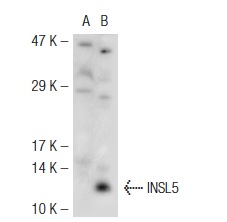
Western blot analysis of INSL5 expression in non-transfected: (A) and mouse INSL5 transfected: (B) 293T whole cell lysates.| Product Name | INSL5 Antibody (M-135) |
|---|---|
| Antibody Type | Primary Antibodies |
| Modification Notes | INSL5 (Insulin-like peptide INSL5, Relaxin/Insulin-like protein) is a 135 amino acid protein encoded by the human gene INSL5. The insulin gene superfamily hormones modulate metabolism, cell growth, and tissue-specific functions. Members of this superfamily are characterized by a signal peptide, a B chain, a connecting C chain and an A chain. Insulin-like peptides (INSL proteins), also designated relaxin-like factors, are mostly secreted proteins that are expressed mainly in testis, placenta, uterus or prenatal tissues. INSL5 shares 40% and 59% sequence homology with human RLN1 and mouse Insl5, respectively, and contains a dibasic cleavage site between the B and C chains. INSL5 exists as a heterodimer of a B chain and an A chain which are linked by two disulfide bonds. INSL5 is thought to play a role in gut contractility or in thymic development and regulation, as it demonstrates predominant expression in the rectum and intermediate expression in the uterus and ascending and descending colon. |
| Clonality | Polyclonal |
|---|---|
| Isotype | IgG |
| Host Species | Rabbit |
| Tested Applications | WBIPIFELISA |
| recommended for detection of INSL5 precursor, A chain and B chain of mouse and rat origin by WB, IP, IF and ELISA | |
| Species Reactivity | HumanMouseRat |
| Concentration | 1mg/ml |
| Purification | Affinity purified |
| Alternative Names | epitope corresponding to amino acids 1-135 representing full length INSL5 of mouse origin |
|---|---|
| Tissue Specificity | epitope corresponding to amino acids 1-135 representing full length INSL5 of mouse origin |
| Entrez Gene | 23919 |
|---|
Application
Western blot analysis of INSL5 expression in non-transfected: (A) and mouse INSL5 transfected: (B) 293T whole cell lysates.| Application Notes | recommended for detection of INSL5 precursor, A chain and B chain of mouse and rat origin by WB, IP, IF and ELISA |
|---|
| Form | Liquid |
|---|---|
| Storage Instructions | For short-term storage, store at 4° C. For long-term storage, aliquot and store at -20ºC or below. Avoid multiple freeze-thaw cycles. |
| Storage Buffer | phosphate buffered saline , pH 7.4, 150mM NaCl, 0.02% sodium azide and 50% glycerol. |


