Application
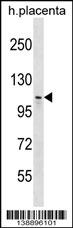
MMS19 Antibody (Center) western blot analysis in human placenta tissue lysates (35ug/lane).This demonstrates the MMS19 antibody detected the MMS19 protein (arrow).| Product Name | MMS19 Antibody (Center) |
|---|---|
| Antibody Type | Primary Antibodies |
| Antigen Alias | MMS19; MMS19L; MMS19 nucleotide excision repair protein homolog; MET18 homolog; MMS19-like protein |
| Clonality | Polyclonal |
|---|---|
| Isotype | Ig |
| Host Species | Rabbit |
| Tested Applications | WB |
| WB:1:100~500 |
|
| Species Reactivity | Human |
| Concentration | 1mg/ml |
| Gene Synonyms | MMS19L |
|---|---|
| Alternative Names | MMS19 MMS19L MMS19 nucleotide excision repair protein homolog MET18 homolog MMS19-like protein |
| Molecular Weight(MW) | 113290 Da |
| Function | Key component of the cytosolic iron-sulfur protein assembly (CIA) complex, a multiprotein complex that mediates the incorporation of iron-sulfur cluster into apoproteins specifically involved in DNA metabolism and genomic integrity. In the CIA complex, MMS19 acts as an adapter between early-acting CIA components and a subset of cellular target iron-sulfur proteins such as ERCC2/XPD, FANCJ and RTEL1, thereby playing a key role in nucleotide excision repair (NER) and RNA polymerase II (POL II) transcription. As part of the mitotic spindle-associated MMXD complex, plays a role in chromosome segregation, probably by facilitating iron-sulfur cluster assembly into ERCC2/XPD Indirectly acts as a transcriptional coactivator of estrogen receptor (ER), via its role in iron-sulfur insertion into some component of the TFIIH-machinery |
| Tissue Specificity | Ubiquitously expressed with higher expression in testis |
| Cellular Localization | Nucleus. Cytoplasm, cytoskeleton, spindle. |
| Entrez Gene | 64210 |
|---|---|
| Nucleotide Accession | NP_071757.4 |
Application
MMS19 Antibody (Center) western blot analysis in human placenta tissue lysates (35ug/lane).This demonstrates the MMS19 antibody detected the MMS19 protein (arrow).| Application Notes | WB:1:100~500 |
|---|
| Form | Liquid |
|---|---|
| Storage Instructions | For short-term storage, store at 4° C. For long-term storage, aliquot and store at -20ºC or below. Avoid multiple freeze-thaw cycles. |
| Storage Buffer | Purified polyclonal antibody supplied in PBS with 0.09% (W/V) sodium azide. This antibody is purified through a protein A column, followed by peptide affinity purification. |


