Application
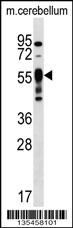
Mouse Camk2g Antibody (N-term) western blot analysis in mouse cerebellum tissue lysates (35ug/lane).This demonstrates the Camk2g antibody detected the Camk2g protein (arrow).| Product Name | Camk2g Antibody (N-term) |
|---|---|
| Antibody Type | Primary Antibodies |
| Antigen Alias | Camk2g; Calcium/calmodulin-dependent protein kinase type II subunit gamma |
| Clonality | Polyclonal |
|---|---|
| Isotype | Ig |
| Host Species | Rabbit |
| Tested Applications | WB |
| WB:1:100~500 |
|
| Species Reactivity | Human |
| Concentration | 1mg/ml |
| Alternative Names | Camk2g Calcium/calmodulin-dependent protein kinase type II subunit gamma |
|---|---|
| Molecular Weight(MW) | 59607 Da |
| Function | Calcium/calmodulin-dependent protein kinase that functions autonomously after Ca(2+)/calmodulin-binding and autophosphorylation, and is involved in sarcoplasmic reticulum Ca(2+) transport in skeletal muscle and may function in dendritic spine and synapse formation and neuronal plasticity. In slow- twitch muscles, is involved in regulation of sarcoplasmic reticulum (SR) Ca(2+) transport and in fast-twitch muscle participates in the control of Ca(2+) release from the SR through phosphorylation of the ryanodine receptor-coupling factor triadin In neurons, may participate in the promotion of dendritic spine and synapse formation and maintenance of synaptic plasticity which enables long-term potentiation (LTP) and hippocampus-dependent learning (By similarity) |
| Tissue Specificity | This Mouse Camk2g antibody is generated from rabbits immunized with a KLH conjugated synthetic peptide between 36-65 amino acids from the N-terminal region of Mouse Camk2g. |
| Cellular Localization | Sarcoplasmic reticulum membrane; Peripheral membrane protein; Cytoplasmic side (Probable) |
| Entrez Gene | 12325 |
|---|---|
| Nucleotide Accession | NP_001034227.1 NP_848712.2 |
Application
Mouse Camk2g Antibody (N-term) western blot analysis in mouse cerebellum tissue lysates (35ug/lane).This demonstrates the Camk2g antibody detected the Camk2g protein (arrow).| Application Notes | WB:1:100~500 |
|---|
| Form | Liquid |
|---|---|
| Storage Instructions | For short-term storage, store at 4° C. For long-term storage, aliquot and store at -20ºC or below. Avoid multiple freeze-thaw cycles. |
| Storage Buffer | Purified polyclonal antibody supplied in PBS with 0.09% (W/V) sodium azide. This antibody is purified through a protein A column, followed by peptide affinity purification. |


