Application
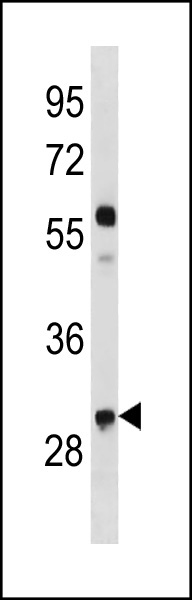
Mouse CCND2 Antibody (C-term T279/T280) western blot analysis in mouse NIH-3T3 cell line lysates (35ug/lane).This demonstrates the Mouse CCND2 antibody detected the Mouse CCND2 protein (arrow).| Product Name | CCND2 Antibody (C-term T279/T280) |
|---|---|
| Antibody Type | Primary Antibodies |
| Antigen Alias | Ccnd2;Cyl-2; G1/S-specific cyclin-D2 |
| Clonality | Polyclonal |
|---|---|
| Isotype | Ig |
| Host Species | Rabbit |
| Tested Applications | WB |
| WB:1:100~500 |
|
| Species Reactivity | Human |
| Concentration | 1mg/ml |
| Gene Synonyms | Cyl-2 |
|---|---|
| Alternative Names | Ccnd2 Cyl-2 G1/S-specific cyclin-D2 |
| Molecular Weight(MW) | 32897 Da |
| Function | Regulatory component of the cyclin D2-CDK4 (DC) complex that phosphorylates and inhibits members of the retinoblastoma (RB) protein family including RB1 and regulates the cell-cycle during G(1)/S transition. Phosphorylation of RB1 allows dissociation of the transcription factor E2F from the RB/E2F complex and the subsequent transcription of E2F target genes which are responsible for the progression through the G(1) phase Hypophosphorylates RB1 in early G(1) phase. Cyclin D-CDK4 complexes are major integrators of various mitogenenic and antimitogenic signals. Also substrate for SMAD3, phosphorylating SMAD3 in a cell-cycle-dependent manner and repressing its transcriptional activity. Component of the ternary complex, cyclin D2/CDK4/CDKN1B, required for nuclear translocation and activity of the cyclin D-CDK4 complex (By similarity) |
| Tissue Specificity | This Mouse CCND2 Antibody Antibody is generated from rabbits immunized with a KLH conjugated synthetic peptide between 265-289 amino acids from the C-term region of mouse CCND2. |
| Cellular Localization | Nucleus (By similarity). Cytoplasm (By similarity). Membrane (By similarity). Note=Cyclin D-CDK4 complexes accumulate at the nuclear membrane and are then translocated into the nucleus through interaction with KIP/CIP family members (By similarity) |
| Entrez Gene | 12444 |
|---|
Application
Mouse CCND2 Antibody (C-term T279/T280) western blot analysis in mouse NIH-3T3 cell line lysates (35ug/lane).This demonstrates the Mouse CCND2 antibody detected the Mouse CCND2 protein (arrow).| Application Notes | WB:1:100~500 |
|---|
| Form | Liquid |
|---|---|
| Storage Instructions | For short-term storage, store at 4° C. For long-term storage, aliquot and store at -20ºC or below. Avoid multiple freeze-thaw cycles. |
| Storage Buffer | Purified polyclonal antibody supplied in PBS with 0.09% (W/V) sodium azide. This antibody is purified through a protein A column, followed by peptide affinity purification. |


