Application
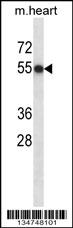
Mouse Csnk1d Antibody (Center) western blot analysis in mouse heart tissue lysates (35ug/lane).This demonstrates the Csnk1d antibody detected the Csnk1d protein (arrow).| Product Name | Csnk1d Antibody (Center) |
|---|---|
| Antibody Type | Primary Antibodies |
| Antigen Alias | Csnk1d; Hckid; Casein kinase I isoform delta; Tau-protein kinase CSNK1D |
| Clonality | Polyclonal |
|---|---|
| Isotype | Ig |
| Host Species | Rabbit |
| Tested Applications | WB |
| WB:1:100~500 |
|
| Species Reactivity | Human |
| Concentration | 1mg/ml |
| Gene Synonyms | Hckid |
|---|---|
| Alternative Names | Csnk1d Hckid Casein kinase I isoform delta Tau-protein kinase CSNK1D |
| Molecular Weight(MW) | 47316 Da |
| Function | Essential serine/threonine-protein kinase that regulates diverse cellular growth and survival processes including Wnt signaling, DNA repair and circadian rhythms. It can phosphorylate a large number of proteins. Casein kinases are operationally defined by their preferential utilization of acidic proteins such as caseins as substrates. Phosphorylates connexin-43/GJA1, MAP1A, SNAPIN, MAPT/TAU, TOP2A, DCK, HIF1A, EIF6, p53/TP53, DVL2, DVL3, ESR1, AIB1/NCOA3, DNMT1, PKD2, YAP1, PER1 and PER2. Central component of the circadian clock. May act as a negative regulator of circadian rhythmicity by phosphorylating PER1 and PER2, leading to retain PER1 in the cytoplasm. YAP1 phosphorylation promotes its SCF(beta-TRCP) E3 ubiquitin ligase-mediated ubiquitination and subsequent degradation. DNMT1 phosphorylation reduces its DNA- binding activity. Phosphorylation of ESR1 and AIB1/NCOA3 stimulates their activity and coactivation. Phosphorylation of DVL2 and DVL3 regulates WNT3A signaling pathway that controls neurite outgrowth. EIF6 phosphorylation promotes its nuclear export. Triggers down-regulation of dopamine receptors in the forebrain. Activates DCK in vitro by phosphorylation. TOP2A phosphorylation favors DNA cleavable complex formation. May regulate the formation of the mitotic spindle apparatus in extravillous trophoblast. Modulates connexin-43/GJA1 gap junction assembly by phosphorylation. Probably involved in lymphocyte physiology. Regulates fast synaptic transmission mediated by glutamate |
| Tissue Specificity | Expressed ubiquitously. However, kinase activity is not uniform, with highest kinase activity in splenocytes |
| Cellular Localization | Cytoplasm (By similarity). Nucleus. Cytoplasm, cytoskeleton, centrosome (By similarity). Cytoplasm, perinuclear region (By similarity). Cell membrane (By similarity) Cytoplasm, cytoskeleton, spindle (By similarity). Golgi apparatus (By similarity). Note=Localized at mitotic spindle microtubules, and at the centrosomes and interphase in interphase cells Recruited to the spindle apparatus and the centrosomes in response to DNA-damage. Correct subcellular localization requires kinase activity (By similarity) |
| Entrez Gene | 104318 |
|---|---|
| Nucleotide Accession | NP_620690.1 |
Application
Mouse Csnk1d Antibody (Center) western blot analysis in mouse heart tissue lysates (35ug/lane).This demonstrates the Csnk1d antibody detected the Csnk1d protein (arrow).| Application Notes | WB:1:100~500 |
|---|
| Form | Liquid |
|---|---|
| Storage Instructions | For short-term storage, store at 4° C. For long-term storage, aliquot and store at -20ºC or below. Avoid multiple freeze-thaw cycles. |
| Storage Buffer | Purified polyclonal antibody supplied in PBS with 0.09% (W/V) sodium azide. This antibody is purified through a protein A column, followed by peptide affinity purification. |


