Application
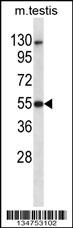
Mouse Dapk3 Antibody (Center) western blot analysis in mouse testis tissue lysates (35ug/lane).This demonstrates the Dapk3 antibody detected the Dapk3 protein (arrow).Application
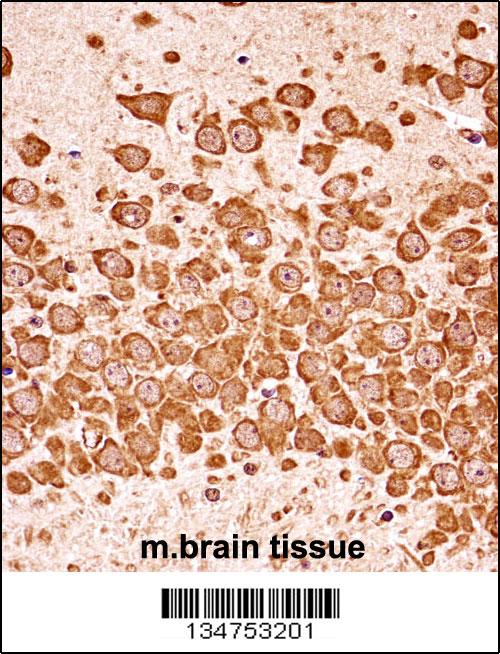
Mouse Dapk3 Antibody (Center) (AP14711c)immunohistochemistry analysis in formalin fixed and paraffin embedded mouse brain tissue followed by peroxidase conjugation of the secondary antibody and DAB staining.This data demonstrates the use of Mouse Dapk3 Antibody (Center) for immunohistochemistry. Clinical relevance has not been evaluated.| Product Name | Dapk3 Antibody (Center) |
|---|---|
| Antibody Type | Primary Antibodies |
| Antigen Alias | Dapk3; Zipk; Death-associated protein kinase 3; DAP-like kinase; MYPT1 kinase; ZIP-kinase |
| Clonality | Polyclonal |
|---|---|
| Isotype | Ig |
| Host Species | Rabbit |
| Tested Applications | WBIHC |
| WB:1:100~500 IHC |
|
| Species Reactivity | Human |
| Concentration | 1mg/ml |
| Gene Synonyms | Zipk |
|---|---|
| Alternative Names | Dapk3 Zipk Death-associated protein kinase 3 DAP-like kinase MYPT1 kinase ZIP-kinase |
| Molecular Weight(MW) | 51422 Da |
| Function | Serine/threonine kinase which is involved in the regulation of apoptosis, autophagy, transcription, translation, actin cytoskeleton reorganization, cell motility, smooth muscle contraction, and mitosis, particularly cytokinesis. Regulates both type I apoptotic and type II autophagic cell deaths signal, depending on the cellular setting. The former is caspase- dependent, while the latter is caspase-independent and is characterized by the accumulation of autophagic vesicles Regulates myosin phosphorylation in both smooth muscle and non- muscle cells. In smooth muscle, regulates myosin either directly by phosphorylating MYL12B and MYL9 or through inhibition of smooth muscle myosin phosphatase (SMPP1M) via phosphorylation of PPP1R12A, and the inhibition of SMPP1M functions to enhance muscle responsiveness to Ca(2+) and promote a contractile state. Enhances transcription from AR-responsive promoters in a hormone- and kinase-dependent manner. Phosphorylates STAT3 and enhances its transcriptional activity. Positively regulates the canonical Wnt/beta-catenin signaling through interaction with NLK and TCF7L2. Can disrupt the NLK-TCF7L2 complex thereby influencing the phosphorylation of TCF7L2 by NLK. Phosphorylates histone H3 on 'Thr-11' at centromeres during mitosis. Involved in the formation of promyelocytic leukemia protein nuclear body (PML-NB), one of many subnuclear domains in the eukaryotic cell nucleus, and which is involved in oncogenesis and viral infection (By similarity) Phosphorylates RPL13A on 'Ser-77' upon interferon-gamma activation which is causing RPL13A release from the ribosome, its association with the GAIT complex and its subsequent involvement in transcript-selective translation inhibition |
| Tissue Specificity | Highly expressed in heart, brain, lung, skeletal muscle, kidney and testis. Lower levels in liver and spleen |
| Cellular Localization | Nucleus. Cytoplasm. Nucleus, PML body (By similarity). Chromosome, centromere. Cytoplasm, cytoskeleton, centrosome (By similarity). Note=Relocates to the cytoplasm on binding PAWR where the complex appears to interact with actin filaments. Localizes to promyelocytic leukemia protein nuclear bodies (PML-NBs). Associated: with the centrosomes throughout the mitotic cell cycle, with the centromeres from prophase to anaphase and with the contractile ring during cytokinesis (By similarity) |
| Entrez Gene | 13144 |
|---|---|
| Nucleotide Accession | NP_031854.1 NP_001177402.1 |
Application
Mouse Dapk3 Antibody (Center) western blot analysis in mouse testis tissue lysates (35ug/lane).This demonstrates the Dapk3 antibody detected the Dapk3 protein (arrow).
Application
Mouse Dapk3 Antibody (Center) (AP14711c)immunohistochemistry analysis in formalin fixed and paraffin embedded mouse brain tissue followed by peroxidase conjugation of the secondary antibody and DAB staining.This data demonstrates the use of Mouse Dapk3 Antibody (Center) for immunohistochemistry. Clinical relevance has not been evaluated.| Application Notes | WB:1:100~500 IHC |
|---|
| Form | Liquid |
|---|---|
| Storage Instructions | For short-term storage, store at 4° C. For long-term storage, aliquot and store at -20ºC or below. Avoid multiple freeze-thaw cycles. |
| Storage Buffer | Purified polyclonal antibody supplied in PBS with 0.09% (W/V) sodium azide. This antibody is purified through a protein A column, followed by peptide affinity purification. |


