Application
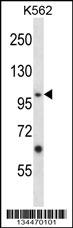
Mouse Epha4 Antibody (Center) western blot analysis in K562 cell line lysates (35ug/lane).This demonstrates the Epha4 antibody detected the Epha4 protein (arrow).Application
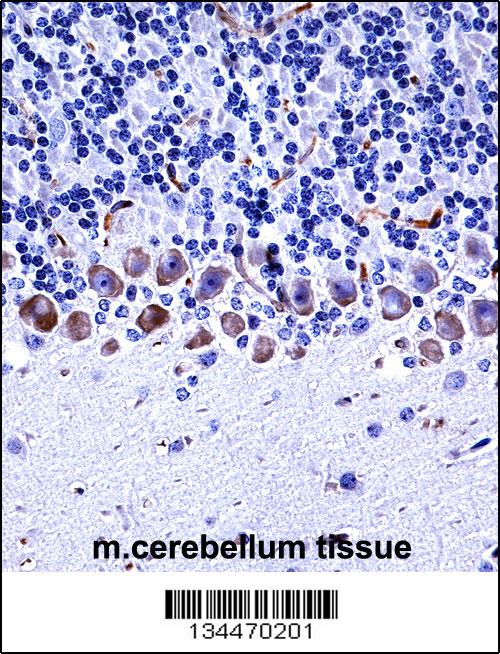
Mouse Epha4 Antibody (Center) (AP13915c)immunohistochemistry analysis in formalin fixed and paraffin embedded mouse cerebellum tissue followed by peroxidase conjugation of the secondary antibody and DAB staining.This data demonstrates the use of Mouse Epha4 Antibody (Center) for immunohistochemistry. Clinical relevance has not been evaluated.| Product Name | Epha4 Antibody (Center) |
|---|---|
| Antibody Type | Primary Antibodies |
| Antigen Alias | Epha4; Sek; Sek1; Ephrin type-A receptor 4; Tyrosine-protein kinase receptor MPK-3; Tyrosine-protein kinase receptor SEK-1 |
| Clonality | Polyclonal |
|---|---|
| Isotype | Ig |
| Host Species | Rabbit |
| Tested Applications | WBIHC |
| WB:1:100~500 IHC |
|
| Species Reactivity | Human |
| Concentration | 1mg/ml |
| Gene Synonyms | Sek Sek1 |
|---|---|
| Alternative Names | Epha4 Sek Sek1 Ephrin type-A receptor 4 Tyrosine-protein kinase receptor MPK-3 Tyrosine-protein kinase receptor SEK-1 |
| Molecular Weight(MW) | 109814 Da |
| Function | Receptor tyrosine kinase which binds membrane-bound ephrin family ligands residing on adjacent cells, leading to contact-dependent bidirectional signaling into neighboring cells The signaling pathway downstream of the receptor is referred to as forward signaling while the signaling pathway downstream of the ephrin ligand is referred to as reverse signaling. Highly promiscuous, it has the unique property among Eph receptors to bind and to be physiologically activated by both GPI-anchored ephrin-A and transmembrane ephrin-B ligands including EFNA1 and EFNB3. Upon activation by ephrin ligands, modulates cell morphology and integrin-dependent cell adhesion through regulation of the Rac, Rap and Rho GTPases activity. Plays an important role in the development of the nervous system controlling different steps of axonal guidance including the establishment of the corticospinal projections. May also control the segregation of motor and sensory axons during neuromuscular circuit development Beside its role in axonal guidance plays a role in synaptic plasticity. Activated by EFNA1 phosphorylates CDK5 at 'Tyr-15' which in turn phosphorylates NGEF regulating RHOA and dendritic spine morphogenesis. In the nervous system, plays also a role in repair after injury preventing axonal regeneration and in angiogenesis playing a role in central nervous system vascular formation. Additionally, its promiscuity makes it available to participate in a variety of cell-cell signaling regulating for instance the development of the thymic epithelium |
| Tissue Specificity | Highest expression in the adult brain and retina and also detectable in kidney, lung, skeletal muscle and thymus. Not detected in heart and liver |
| Cellular Localization | Cell membrane; Single-pass type I membrane protein. Cell projection, axon. Cell projection, dendrite. Cell junction, synapse, postsynaptic cell membrane, postsynaptic density (By similarity). Early endosome. Note=Clustered upon activation and targeted to early endosome |
| Entrez Gene | 13838 |
|---|---|
| Nucleotide Accession | NP_031962.2 |
Application
Mouse Epha4 Antibody (Center) western blot analysis in K562 cell line lysates (35ug/lane).This demonstrates the Epha4 antibody detected the Epha4 protein (arrow).
Application
Mouse Epha4 Antibody (Center) (AP13915c)immunohistochemistry analysis in formalin fixed and paraffin embedded mouse cerebellum tissue followed by peroxidase conjugation of the secondary antibody and DAB staining.This data demonstrates the use of Mouse Epha4 Antibody (Center) for immunohistochemistry. Clinical relevance has not been evaluated.| Application Notes | WB:1:100~500 IHC |
|---|
| Form | Liquid |
|---|---|
| Storage Instructions | For short-term storage, store at 4° C. For long-term storage, aliquot and store at -20ºC or below. Avoid multiple freeze-thaw cycles. |
| Storage Buffer | Purified polyclonal antibody supplied in PBS with 0.09% (W/V) sodium azide. This antibody is purified through a protein A column, followed by peptide affinity purification. |


