Application
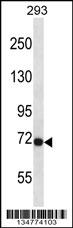
Mouse Fgfr3 Antibody (Center) western blot analysis in 293 cell line lysates (35ug/lane).This demonstrates the Fgfr3 antibody detected the Fgfr3 protein (arrow).Application
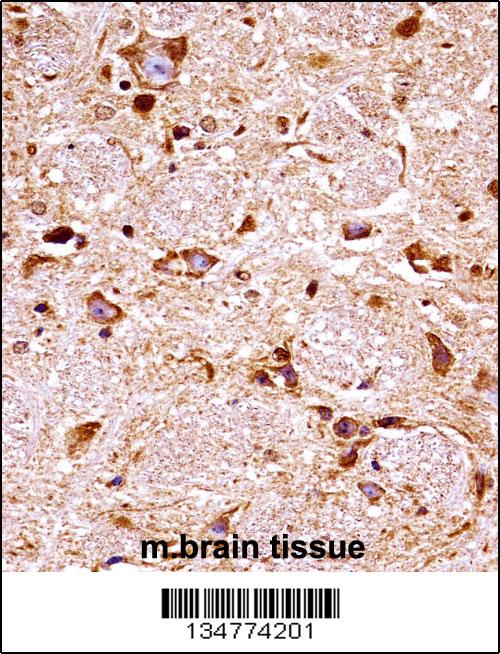
VN1R1 Antibody (N-term) (AP14841c)immunohistochemistry analysis in formalin fixed and paraffin embedded mouse brain tissue followed by peroxidase conjugation of the secondary antibody and DAB staining.This data demonstrates the use of VN1R1 Antibody (N-term) for immunohistochemistry. Clinical relevance has not been evaluated.| Product Name | Fgfr3 Antibody (Center) |
|---|---|
| Antibody Type | Primary Antibodies |
| Antigen Alias | Fgfr3; Mfr3; Sam3; Fibroblast growth factor receptor 3; Heparin-binding growth factor receptor; CD_antigen=CD333; Flags: Precursor |
| Clonality | Polyclonal |
|---|---|
| Isotype | Ig |
| Host Species | Rabbit |
| Tested Applications | WBIHC |
| WB:1:100~500 IHC |
|
| Species Reactivity | Human |
| Concentration | 1mg/ml |
| Gene Synonyms | Mfr3 Sam3 |
|---|---|
| Alternative Names | Fgfr3 Mfr3 Sam3 Fibroblast growth factor receptor 3 Heparin-binding growth factor receptor CD_antigen=CD333 Flags: Precursor |
| Molecular Weight(MW) | 87758 Da |
| Function | Tyrosine-protein kinase that acts as cell-surface receptor for fibroblast growth factors and plays an essential role in the regulation of cell proliferation, differentiation and apoptosis. Plays an essential role in the regulation of chondrocyte differentiation, proliferation and apoptosis, and is required for normal skeleton development. Regulates both osteogenesis and postnatal bone mineralization by osteoblasts Promotes apoptosis in chondrocytes, but can also promote cancer cell proliferation. Required for normal development of the inner ear. Phosphorylates PLCG1, CBL and FRS2. Ligand binding leads to the activation of several signaling cascades. Activation of PLCG1 leads to the production of the cellular signaling molecules diacylglycerol and inositol 1,4,5-trisphosphate. Phosphorylation of FRS2 triggers recruitment of GRB2, GAB1, PIK3R1 and SOS1, and mediates activation of RAS, MAPK1/ERK2, MAPK3/ERK1 and the MAP kinase signaling pathway, as well as of the AKT1 signaling pathway. Plays a role in the regulation of vitamin D metabolism Mutations that lead to constitutive kinase activation or impair normal FGFR3 maturation, internalization and degradation lead to aberrant signaling. Over-expressed or constitutively activated FGFR3 promotes activation of STAT1, STAT5A and STAT5B. Plays a role in postnatal lung development |
| Tissue Specificity | In embryo, expressed in heart, lung, kidney, skin, head and liver but not in muscle. In adult, highest levels in brain. Also expressed in liver, lung, kidney, testis, ovary and uterus. Very low levels in heart, thymus, spleen and muscle |
| Cellular Localization | Cell membrane; Single-pass type I membrane protein. Cytoplasmic vesicle (By similarity). Endoplasmic reticulum (By similarity). Note=The activated receptor is rapidly internalized and degraded. Detected in intracellular vesicles after internalization of the autophosphorylated receptor (By similarity) |
Application
Mouse Fgfr3 Antibody (Center) western blot analysis in 293 cell line lysates (35ug/lane).This demonstrates the Fgfr3 antibody detected the Fgfr3 protein (arrow).
Application
VN1R1 Antibody (N-term) (AP14841c)immunohistochemistry analysis in formalin fixed and paraffin embedded mouse brain tissue followed by peroxidase conjugation of the secondary antibody and DAB staining.This data demonstrates the use of VN1R1 Antibody (N-term) for immunohistochemistry. Clinical relevance has not been evaluated.| Application Notes | WB:1:100~500 IHC |
|---|
| Form | Liquid |
|---|---|
| Storage Instructions | For short-term storage, store at 4° C. For long-term storage, aliquot and store at -20ºC or below. Avoid multiple freeze-thaw cycles. |
| Storage Buffer | Purified polyclonal antibody supplied in PBS with 0.09% (W/V) sodium azide. This antibody is purified through a protein A column, followed by peptide affinity purification. |


