Application
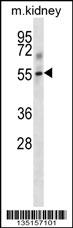
Mouse Tgfbr1 Antibody (Center) western blot analysis in mouse kidney tissue lysates (35ug/lane).This demonstrates the Tgfbr1 antibody detected the Tgfbr1 protein (arrow).| Product Name | Tgfbr1 Antibody (Center) |
|---|---|
| Antibody Type | Primary Antibodies |
| Clonality | Polyclonal |
|---|---|
| Isotype | Ig |
| Host Species | Rabbit |
| Tested Applications | WB |
| WB:1:100~500 |
|
| Species Reactivity | Human |
| Concentration | 1mg/ml |
| Alternative Names | Tgfbr1 TGF-beta receptor type-1 ESK2 Transforming growth factor-beta receptor type I |
|---|---|
| Molecular Weight(MW) | 56179 Da |
| Function | Transmembrane serine/threonine kinase forming with the TGF-beta type II serine/threonine kinase receptor, TGFBR2, the non-promiscuous receptor for the TGF-beta cytokines TGFB1, TGFB2 and TGFB3. Transduces the TGFB1, TGFB2 and TGFB3 signal from the cell surface to the cytoplasm and is thus regulating a plethora of physiological and pathological processes including cell cycle arrest in epithelial and hematopoietic cells, control of mesenchymal cell proliferation and differentiation, wound healing, extracellular matrix production, immunosuppression and carcinogenesis. The formation of the receptor complex composed of 2 TGFBR1 and 2 TGFBR2 molecules symmetrically bound to the cytokine dimer results in the phosphorylation and the activation of TGFBR1 by the constitutively active TGFBR2. Activated TGFBR1 phosphorylates SMAD2 which dissociates from the receptor and interacts with SMAD4. The SMAD2-SMAD4 complex is subsequently translocated to the nucleus where it modulates the transcription of the TGF-beta-regulated genes. This constitutes the canonical SMAD-dependent TGF-beta signaling cascade. Also involved in non- canonical, SMAD-independent TGF-beta signaling pathways. For instance, TGFBR1 induces TRAF6 autoubiquitination which in turn results in MAP3K7 ubiquitination and activation to trigger apoptosis. Also regulates epithelial to mesenchymal transition through a SMAD-independent signaling pathway through PARD6A phosphorylation and activation (By similarity) |
| Tissue Specificity | This Mouse Tgfbr1 antibody is generated from rabbits immunized with a KLH conjugated synthetic peptide between 140-169 amino acids from the Central region of Mouse Tgfbr1. |
| Cellular Localization | Cell membrane; Single-pass type I membrane protein (By similarity). Cell junction, tight junction (By similarity) |
| Entrez Gene | 21812 |
|---|---|
| Nucleotide Accession | NP_033396.1 |
Application
Mouse Tgfbr1 Antibody (Center) western blot analysis in mouse kidney tissue lysates (35ug/lane).This demonstrates the Tgfbr1 antibody detected the Tgfbr1 protein (arrow).| Application Notes | WB:1:100~500 |
|---|
| Form | Liquid |
|---|---|
| Storage Instructions | For short-term storage, store at 4° C. For long-term storage, aliquot and store at -20ºC or below. Avoid multiple freeze-thaw cycles. |
| Storage Buffer | Purified polyclonal antibody supplied in PBS with 0.09% (W/V) sodium azide. This antibody is purified through a protein A column, followed by peptide affinity purification. |


