Application
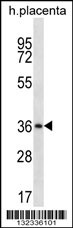
MUL1 Antibody (C-term) western blot analysis in human placenta tissue lysates (35ug/lane).This demonstrates the MUL1 antibody detected the MUL1 protein (arrow).| Product Name | MUL1 Antibody (C-term) |
|---|---|
| Antibody Type | Primary Antibodies |
| Antigen Alias | MUL1; C1orf166; GIDE; MAPL; MULAN; RNF218; Mitochondrial ubiquitin ligase activator of NFKB 1; E3 SUMO-protein ligase MUL1; E3 ubiquitin-protein ligase MUL1; Growth inhibition and death E3 ligase; Mitochondrial-anchored protein ligase; Putative NF-kappa-B- |
| Clonality | Polyclonal |
|---|---|
| Isotype | Ig |
| Host Species | Rabbit |
| Tested Applications | WB |
| WB:1:100~500 |
|
| Species Reactivity | Human |
| Concentration | 1mg/ml |
| Gene Synonyms | C1orf166 GIDE MAPL MULAN RNF218 |
|---|---|
| Alternative Names | MUL1 C1orf166 GIDE MAPL MULAN RNF218 Mitochondrial ubiquitin ligase activator of NFKB 1 E3 SUMO-protein ligase MUL1 E3 ubiquitin-protein ligase MUL1 Growth inhibition and death E3 ligase Mitochondrial-anchored protein ligase Putative NF-kappa-B- |
| Molecular Weight(MW) | 39800 Da |
| Function | Exhibits weak E3 ubiquitin-protein ligase activity, but preferentially acts as a SUMO E3 ligase at physiological concentrations. Plays a role in the control of mitochondrial morphology. Promotes mitochondrial fragmentation and influences mitochondrial localization. Inhibits cell growth. When overexpressed, activates JNK through MAP3K7/TAK1 and induces caspase-dependent apoptosis. E3 ubiquitin ligases accept ubiquitin from an E2 ubiquitin-conjugating enzyme in the form of a thioester and then directly transfer the ubiquitin to targeted substrates |
| Tissue Specificity | Widely expressed with highest levels in the heart, skeletal muscle, placenta, kidney and liver. Barely detectable in colon and thymus |
| Cellular Localization | Mitochondrion outer membrane; Multi-pass membrane protein. Peroxisome. Note=Transported in mitochondrion- derived vesicles from the mitochondrion to the peroxisome |
| Entrez Gene | 79594 |
|---|---|
| Nucleotide Accession | NP_078820.2 |
Application
MUL1 Antibody (C-term) western blot analysis in human placenta tissue lysates (35ug/lane).This demonstrates the MUL1 antibody detected the MUL1 protein (arrow).| Application Notes | WB:1:100~500 |
|---|
| Form | Liquid |
|---|---|
| Storage Instructions | For short-term storage, store at 4° C. For long-term storage, aliquot and store at -20ºC or below. Avoid multiple freeze-thaw cycles. |
| Storage Buffer | Purified polyclonal antibody supplied in PBS with 0.09% (W/V) sodium azide. This antibody is purified through a protein A column, followed by peptide affinity purification. |


