Application
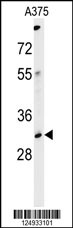
Western blot analysis of NMRL1 Antibody (N-term)() in A375 cell line lysates (35ug/lane). NMRL1 (arrow) was detected using the purified Pab.| Product Name | NMRL1 Antibody (N-term) |
|---|---|
| Antibody Type | Primary Antibodies |
| Clonality | Polyclonal |
|---|---|
| Isotype | Ig |
| Host Species | Rabbit |
| Tested Applications | WB |
| WB:1:100~500 |
|
| Species Reactivity | Human |
| Concentration | 1mg/ml |
| Gene Synonyms | HSCARG |
|---|---|
| Alternative Names | NMRAL1 HSCARG NmrA-like family domain-containing protein 1 |
| Molecular Weight(MW) | 33344 Da |
| Function | Redox sensor protein. Undergoes restructuring and subcellular redistribution in response to changes in intracellular NADPH/NADP(+) levels. At low NADPH concentrations the protein is found mainly as a monomer, and binds argininosuccinate synthase (ASS1), the enzyme involved in nitric oxide synthesis. Association with ASS1 impairs its activity and reduces the production of nitric oxide, which subsecuently prevents apoptosis. Under normal NADPH concentrations, the protein is found as a dimer and hides the binding site for ASS1. The homodimer binds one molecule of NADPH. Has higher affinity for NADPH than for NADP(+). Binding to NADPH is necessary to form a stable dimer |
| Tissue Specificity | This NMRL1 antibody is generated from rabbits immunized with a KLH conjugated synthetic peptide between 29~58 amino acids from the N-terminal region of human NMRL1. |
| Cellular Localization | Cytoplasm. Cytoplasm, perinuclear region. Nucleus. Note=Under normal redox growth conditions localizes in the cytoplasm and perinuclear region. Nuclear localization is promoted by increased intracellular nitric oxide and reduced NADPH/NADP(+) ratios |
| Entrez Gene | 57407 |
|---|
Application
Western blot analysis of NMRL1 Antibody (N-term)() in A375 cell line lysates (35ug/lane). NMRL1 (arrow) was detected using the purified Pab.| Application Notes | WB:1:100~500 |
|---|
| Form | Liquid |
|---|---|
| Storage Instructions | For short-term storage, store at 4° C. For long-term storage, aliquot and store at -20ºC or below. Avoid multiple freeze-thaw cycles. |
| Storage Buffer | Purified polyclonal antibody supplied in PBS with 0.09% (W/V) sodium azide. This antibody is purified through a protein A column, followed by peptide affinity purification. |


