Application
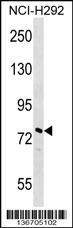
NOLC1 Antibody (N-term) western blot analysis in NCI-H292 cell line lysates (35ug/lane).This demonstrates the NOLC1 antibody detected the NOLC1 protein (arrow).| Product Name | NOLC1 Antibody (N-term) |
|---|---|
| Antibody Type | Primary Antibodies |
| Antigen Alias | NOLC1; KIAA0035; NS5ATP13; Nucleolar and coiled-body phosphoprotein 1; 140 kDa nucleolar phosphoprotein; Hepatitis C virus NS5A-transactivated protein 13; Nucleolar 130 kDa protein; Nucleolar phosphoprotein p130 |
| Clonality | Polyclonal |
|---|---|
| Isotype | Ig |
| Host Species | Rabbit |
| Tested Applications | WB |
| WB:1:100~500 |
|
| Species Reactivity | Human |
| Concentration | 1mg/ml |
| Gene Synonyms | KIAA0035 NS5ATP13 |
|---|---|
| Alternative Names | NOLC1 KIAA0035 NS5ATP13 Nucleolar and coiled-body phosphoprotein 1 140 kDa nucleolar phosphoprotein Hepatitis C virus NS5A-transactivated protein 13 Nucleolar 130 kDa protein Nucleolar phosphoprotein p130 |
| Molecular Weight(MW) | 73603 Da |
| Function | Related to nucleologenesis, may play a role in the maintenance of the fundamental structure of the fibrillar center and dense fibrillar component in the nucleolus. It has intrinsic GTPase and ATPase activities. May play an important role in transcription catalyzed by RNA polymerase I |
| Tissue Specificity | This NOLC1 antibody is generated from rabbits immunized with a KLH conjugated synthetic peptide between 161-191 amino acids from the N-terminal region of human NOLC1. |
| Cellular Localization | Nucleus, nucleolus. Cytoplasm. Note=Shuttles between the nucleolus and the cytoplasm. At telophase it begins to assemble into granular-like pre-nucleolar bodies which are subsequently relocated to nucleoli at the early G1-phase |
| Entrez Gene | 9221 |
|---|---|
| Nucleotide Accession | NP_004732.2 |
Application
NOLC1 Antibody (N-term) western blot analysis in NCI-H292 cell line lysates (35ug/lane).This demonstrates the NOLC1 antibody detected the NOLC1 protein (arrow).| Application Notes | WB:1:100~500 |
|---|
| Form | Liquid |
|---|---|
| Storage Instructions | For short-term storage, store at 4° C. For long-term storage, aliquot and store at -20ºC or below. Avoid multiple freeze-thaw cycles. |
| Storage Buffer | Purified polyclonal antibody supplied in PBS with 0.09% (W/V) sodium azide. This antibody is purified through a protein A column, followed by peptide affinity purification. |


