Application
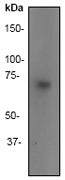
A. Western blot analysis on A431 cell lysate using anti p63 (p73L) RabMAb (Cat. #AJ1576a). dilution 1: 20,000Application
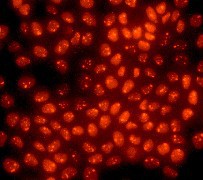
B. Immunofluorescent staining of A431 cells using anti-p63 (p73L) RabMAb (Cat. #AJ1576a).| Product Name | p63 (p73L) Antibody (C-term) |
|---|---|
| Antibody Type | Primary Antibodies |
| Antigen Alias | TP63, KET, P63, P73H, P73L, TP73L, Tumor protein 63, p51;p40;Keratinocyte transcription factor KET;Chronic ulcerative stomatitis protein |
| Clonality | Monoclonal |
|---|---|
| Clone Number | Y289 |
| Host Species | Rabbit |
| Tested Applications | WBIF |
| WB:1:2000 |
|
| Species Reactivity | Human |
| Concentration | 1mg/ml |
| Gene Synonyms | KET P63 P73H P73L TP73L |
|---|---|
| Alternative Names | TP63 KET P63 P73H P73L TP73L Tumor protein 63 p51 p40 Keratinocyte transcription factor KET Chronic ulcerative stomatitis protein |
| Molecular Weight(MW) | 76785 Da |
| Function | Acts as a sequence specific DNA binding transcriptional activator or repressor. The isoforms contain a varying set of transactivation and auto-regulating transactivation inhibiting domains thus showing an isoform specific activity. Isoform 2 activates RIPK4 transcription. May be required in conjunction with TP73/p73 for initiation of p53/TP53 dependent apoptosis in response to genotoxic insults and the presence of activated oncogenes. Involved in Notch signaling by probably inducing JAG1 and JAG2. Plays a role in the regulation of epithelial morphogenesis. The ratio of DeltaN-type and TA*-type isoforms may govern the maintenance of epithelial stem cell compartments and regulate the initiation of epithelial stratification from the undifferentiated embryonal ectoderm. Required for limb formation from the apical ectodermal ridge. Activates transcription of the p21 promoter |
| Tissue Specificity | Widely expressed, notably in heart, kidney, placenta, prostate, skeletal muscle, testis and thymus, although the precise isoform varies according to tissue type. Progenitor cell layers of skin, breast, eye and prostate express high levels of DeltaN-type isoforms. Isoform 10 is predominantly expressed in skin squamous cell carcinomas, but not in normal skin tissues |
| Cellular Localization | Nucleus. |
| Entrez Gene | 8626 |
|---|
Application
A. Western blot analysis on A431 cell lysate using anti p63 (p73L) RabMAb (Cat. #AJ1576a). dilution 1: 20,000
Application
B. Immunofluorescent staining of A431 cells using anti-p63 (p73L) RabMAb (Cat. #AJ1576a).| Application Notes | WB:1:2000 |
|---|
| Form | Liquid |
|---|---|
| Storage Instructions | For short-term storage, store at 4° C. For long-term storage, aliquot and store at -20ºC or below. Avoid multiple freeze-thaw cycles. |
| Storage Buffer | 50 mM Tris-Glycine (pH 7.4), 0.15 M NaCl, 40% Glycerol, 0.01% sodium azide and 0.05% BSA. |


