Application
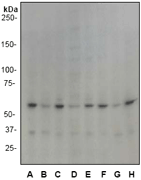
A. Western blot analysis of anti- PAK1 (N-term) RabMAb (Cat. #AJ1583b), dilution 1:500 A: Hela B: A431 C: Jurkat D: K562 E: MCF7 F: Daudi G: NIH 3T3 H: PC12Application
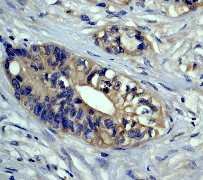
B. Immunohistochemical analysis of paraffin-embedded human breast carcinoma using anti-PAK1 (N-term) RabMAb (Cat. #AJ1583b).Application
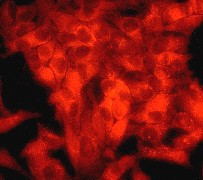
C. Immunofluorescent staining of HeLa cells using anti-PAK1 (N-term) RabMAb (Cat. #AJ1583b).| Product Name | PAK1 Antibody (N-term) |
|---|---|
| Antibody Type | Primary Antibodies |
| Antigen Alias | PAK1, Serine/threonine-protein kinase PAK 1, p65-PAK;Alpha-PAK |
| Clonality | Monoclonal |
|---|---|
| Clone Number | EP795Y |
| Host Species | Rabbit |
| Tested Applications | WBIHCIF |
| WB:1:1000~2000 IHC |
|
| Species Reactivity | Human |
| Concentration | 1mg/ml |
| Alternative Names | PAK1 Serine/threonine-protein kinase PAK 1 p65-PAK Alpha-PAK |
|---|---|
| Molecular Weight(MW) | 60647 Da |
| Function | Protein kinase involved in intracellular signaling pathways downstream of integrins and receptor-type kinases that plays an important role in cytoskeleton dynamics, in cell adhesion, migration, proliferation, apoptosis, mitosis, and in vesicle-mediated transport processes. Can directly phosphorylate BAD and protects cells against apoptosis. Activated by interaction with CDC42 and RAC1. Functions as GTPase effector that links the Rho-related GTPases CDC42 and RAC1 to the JNK MAP kinase pathway Phosphorylates and activates MAP2K1, and thereby mediates activation of downstream MAP kinases. Involved in the reorganization of the actin cytoskeleton, actin stress fibers and of focal adhesion complexes. Phosphorylates the tubulin chaperone TBCB and thereby plays a role in the regulation of microtubule biogenesis and organization of the tubulin cytoskeleton. Plays a role in the regulation of insulin secretion in response to elevated glucose levels. Part of a ternary complex that contains PAK1, DVL1 and MUSK that is important for MUSK-dependent regulation of AChR clustering during the formation of the neuromuscular junction (NMJ). Activity is inhibited in cells undergoing apoptosis, potentially due to binding of CDC2L1 and CDC2L2. Phosphorylates MYL9/MLC2. Phosphorylates RAF1 at 'Ser-338' and 'Ser-339' resulting in: activation of RAF1, stimulation of RAF1 translocation to mitochondria, phosphorylation of BAD by RAF1, and RAF1 binding to BCL2. Phosphorylates SNAI1 at 'Ser-246' promoting its transcriptional repressor activity by increasing its accumulation in the nucleus |
| Tissue Specificity | A synthetic peptide corresponding to residues in the N-terminus of human PAK1 protein was used as immunogen. |
| Cellular Localization | Cytoplasm. Cell junction, focal adhesion. Cell membrane. Note=Recruited to the cell membrane by interaction with CDC42 and RAC1. Recruited to focal adhesions upon activation |
| Entrez Gene | 5058 |
|---|
Application
A. Western blot analysis of anti- PAK1 (N-term) RabMAb (Cat. #AJ1583b), dilution 1:500 A: Hela B: A431 C: Jurkat D: K562 E: MCF7 F: Daudi G: NIH 3T3 H: PC12
Application
B. Immunohistochemical analysis of paraffin-embedded human breast carcinoma using anti-PAK1 (N-term) RabMAb (Cat. #AJ1583b).
Application
C. Immunofluorescent staining of HeLa cells using anti-PAK1 (N-term) RabMAb (Cat. #AJ1583b).| Application Notes | WB:1:1000~2000 IHC |
|---|
| Form | Liquid |
|---|---|
| Storage Instructions | For short-term storage, store at 4° C. For long-term storage, aliquot and store at -20ºC or below. Avoid multiple freeze-thaw cycles. |
| Storage Buffer | 50 mM Tris-Glycine (pH 7.4), 0.15 M NaCl, 40% Glycerol, 0.01% sodium azide and 0.05% BSA. |


