Application
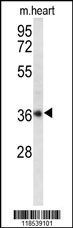
Western blot analysis of PAWR Antibody (Center) in mouse heart tissue lysates (35ug/lane). PAWR (arrow) was detected using the purified Pab.| Product Name | PAWR Antibody (Center) |
|---|---|
| Antibody Type | Primary Antibodies |
| Antigen Alias | PAWR; PAR4; PRKC apoptosis WT1 regulator protein; Prostate apoptosis response 4 protein |
| Clonality | Polyclonal |
|---|---|
| Isotype | Ig |
| Host Species | Rabbit |
| Tested Applications | WB |
| WB:1:50~100 |
|
| Species Reactivity | Human |
| Concentration | 1mg/ml |
| Gene Synonyms | PAR4 |
|---|---|
| Alternative Names | PAWR PAR4 PRKC apoptosis WT1 regulator protein Prostate apoptosis response 4 protein |
| Molecular Weight(MW) | 36568 Da |
| Function | Pro-apoptopic protein capable of selectively inducing apoptosis in cancer cells, sensitizing the cells to diverse apoptotic stimuli and causing regression of tumors in animal models. Induces apoptosis in certain cancer cells by activation of the Fas prodeath pathway and coparallel inhibition of NF-kappa-B transcriptional activity. Inhibits the transcriptional activation and augments the transcriptional repression mediated by WT1. Down- regulates the anti-apoptotic protein BCL2 via its interaction with WT1. Seems also to be a transcriptional repressor by itself. May be directly involved in regulating the amyloid precursor protein (APP) cleavage activity of BACE1 |
| Tissue Specificity | Widely expressed. Expression is elevated in various neurodegenerative diseases such as amyotrophic lateral sclerosis, Alzheimer, Parkinson and Huntington diseases and stroke. Down-regulated in several cancers |
| Cellular Localization | Cytoplasm. Nucleus. Note=Mainly cytoplasmic in absence of apoptosis signal and in normal cells. Nuclear in most cancer cell lines. Nuclear entry seems to be essential but not sufficient for apoptosis (By similarity). Nuclear localization includes nucleoplasm and PML nuclear bodies |
| Entrez Gene | 5074 |
|---|
Application
Western blot analysis of PAWR Antibody (Center) in mouse heart tissue lysates (35ug/lane). PAWR (arrow) was detected using the purified Pab.| Application Notes | WB:1:50~100 |
|---|
| Form | Liquid |
|---|---|
| Storage Instructions | For short-term storage, store at 4° C. For long-term storage, aliquot and store at -20ºC or below. Avoid multiple freeze-thaw cycles. |
| Storage Buffer | Purified polyclonal antibody supplied in PBS with 0.09% (W/V) sodium azide. This antibody is prepared by Saturated Ammonium Sulfate (SAS) precipitation followed by dialysis against PBS. |


