Application
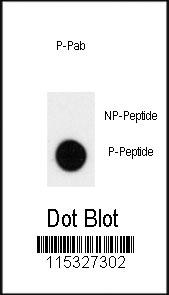
Dot blot analysis of anti-Phospho-CASC3-Y181 Pab on nitrocellulose membrane. 50ng of Phospho-peptide or Non Phospho-peptide per dot were adsorbed. Antibody working concentrations are 0.5ug per ml.| Product Name | Phospho-CASC3-Y181 Antibody |
|---|---|
| Antibody Type | Primary Antibodies |
| Modification | p-Y181 |
| Clonality | Polyclonal |
|---|---|
| Isotype | Ig |
| Host Species | Rabbit |
| Tested Applications | DB |
| DB:1:500 |
|
| Species Reactivity | Human |
| Concentration | 1mg/ml |
| Gene Synonyms | MLN51 |
|---|---|
| Alternative Names | CASC3 MLN51 Protein CASC3 Cancer susceptibility candidate gene 3 protein Metastatic lymph node gene 51 protein Protein barentsz |
| Molecular Weight(MW) | 76278 Da |
| Function | Component of a splicing-dependent multiprotein exon junction complex (EJC) deposited at splice junction on mRNAs. The EJC is a dynamic structure consisting of a few core proteins and several more peripheral nuclear and cytoplasmic associated factors that join the complex only transiently either during EJC assembly or during subsequent mRNA metabolism. Core components of the EJC, that remains bound to spliced mRNAs throughout all stages of mRNA metabolism, functions to mark the position of the exon-exon junction in the mature mRNA and thereby influences downstream processes of gene expression including mRNA splicing, nuclear mRNA export, subcellular mRNA localization, translation efficiency and nonsense-mediated mRNA decay (NMD). Stimulates the ATPase and RNA- helicase activities of EIF4A3. Plays a role in the stress response by participating in cytoplasmic stress granules assembly and by favoring cell recovery following stress. Component of the dendritic ribonucleoprotein particles (RNPs) in hippocampal neurons (By similarity). May play a role in mRNA transport (By similarity). Binds spliced mRNA in sequence-independent manner, 20-24 nucleotides upstream of mRNA exon-exon junctions. Binds poly(G) and poly(U) RNA homopolymer |
| Tissue Specificity | Widely expressed. Overexpressed in breast cancers and metastasis, as well as in gastric cancers |
| Cellular Localization | Cytoplasm, perinuclear region. Nucleus. Nucleus speckle. Note=Predominantly found in the perinuclear region (By similarity). Shuttles between the nucleus and the cytoplasm in a CRM1-dependent manner. Travels to the cytoplasm as part of the exon junction complex (EJC) bound to mRNA. Shuttles between the cytoplasm and the stress granules. More specifically found in nuclear intrachromatin granules clusters (IGC), also called nuclear speckles, which are storage compartments for nuclear proteins involved in mRNA processing. Colocalizes in nuclear speckles with MAGOH. Under stress condition, colocalizes with FMR1 and TIA1, but not MAGOH and RBM8A EJC core factors, in cytoplasmic stress granules, which contain stored mRNAs whose translation is stopped in response to stress |
Application
Dot blot analysis of anti-Phospho-CASC3-Y181 Pab on nitrocellulose membrane. 50ng of Phospho-peptide or Non Phospho-peptide per dot were adsorbed. Antibody working concentrations are 0.5ug per ml.| Application Notes | DB:1:500 |
|---|
| Form | Liquid |
|---|---|
| Storage Instructions | For short-term storage, store at 4° C. For long-term storage, aliquot and store at -20ºC or below. Avoid multiple freeze-thaw cycles. |
| Storage Buffer | Purified polyclonal antibody supplied in PBS with 0.09% (W/V) sodium azide. This antibody is purified through a protein A column, followed by two-step phosphospecific peptide affinity purification. |


