Application
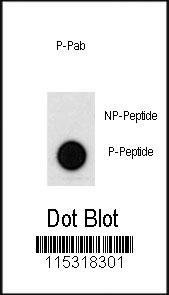
Dot blot analysis of anti-Phospho-PMAT-Y198 Antibody on nitrocellulose membrane. 50ng of Phospho-peptide or Non Phospho-peptide per dot were adsorbed. Antibody working concentrations are 0.5ug per ml.| Product Name | Phospho-PMAT-Y198 Antibody |
|---|---|
| Antibody Type | Primary Antibodies |
| Antigen Alias | SLC29A4; ENT4; PMAT; Equilibrative nucleoside transporter 4; Plasma membrane monoamine transporter; Solute carrier family 29 member 4 |
| Modification | p-Y198 |
| Clonality | Polyclonal |
|---|---|
| Isotype | Ig |
| Host Species | Rabbit |
| Tested Applications | DB |
| DB:1:500 |
|
| Species Reactivity | Human |
| Concentration | 1mg/ml |
| Gene Synonyms | ENT4 PMAT |
|---|---|
| Alternative Names | SLC29A4 ENT4 PMAT Equilibrative nucleoside transporter 4 Plasma membrane monoamine transporter Solute carrier family 29 member 4 |
| Molecular Weight(MW) | 58059 Da |
| Function | Functions as a polyspecific organic cation transporter, efficiently transporting many organic cations such as monoamine neurotransmitters 1-methyl-4-phenylpyridinium and biogenic amines including serotonin, dopamine, norepinephrine and epinephrine. May play a role in regulating central nervous system homeostasis of monoamine neurotransmitters. May be involved in luminal transport of organic cations in the kidney and seems to use luminal proton gradient to drive organic cation reabsorption. Does not seem to transport nucleoside and nucleoside analogs such as uridine, cytidine, thymidine, adenosine, inosine, guanosine, and azidothymidine. In (PubMed:16873718) adenosine is efficiently transported but in a fashion highly sensitive to extracellular pH, with maximal activity in the pH range 5.5 to 6.5. Glu-206 is essential for the cation selectivity and may function as the charge sensor for cationic substrates. Transport is chloride and sodium-independent but appears to be sensitive to changes in membrane potential. Weakly inhibited by the classical inhibitors of equilibrative nucleoside transport, dipyridamole, dilazep, and nitrobenzylthioinosine. May play a role in the regulation of extracellular adenosine concentrations in cardiac tissues, in particular during ischemia |
| Tissue Specificity | Expressed abundantly in the heart, in both cardiomyocytes and vascular endothelial cells (at protein level) Highly expressed in brain, kidney and skeletal muscle. In the brain expressed in cerebellum, cerebral cortex, medulla, occipital pole, frontal and temporal lobes putamen and in the spinal cord Lower expression in liver, pancreas, and liver. Expressed in endometrial tissue, exclusively in the stroma. Expression is high in the proliferative phase, decreases during the secretory phase, and is no longer detectable in the menstrual phase |
| Cellular Localization | Cell membrane; Multi-pass membrane protein (Potential). Apical cell membrane; Multi-pass membrane protein (Potential). Note=Located to the plasma membranes of ventricular myocytes and vascular endothelial cells. Targeted to the apical membranes of differentiated kidney epithelial cells |
| Entrez Gene | 222962 |
|---|
Application
Dot blot analysis of anti-Phospho-PMAT-Y198 Antibody on nitrocellulose membrane. 50ng of Phospho-peptide or Non Phospho-peptide per dot were adsorbed. Antibody working concentrations are 0.5ug per ml.| Application Notes | DB:1:500 |
|---|
| Form | Liquid |
|---|---|
| Storage Instructions | For short-term storage, store at 4° C. For long-term storage, aliquot and store at -20ºC or below. Avoid multiple freeze-thaw cycles. |
| Storage Buffer | Purified polyclonal antibody supplied in PBS with 0.09% (W/V) sodium azide. This antibody is purified through a protein A column, followed by two-step phosphospecific peptide affinity purification. |


