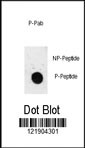
Application
Dot blot analysis of anti-Phospho-specific[JW] Phospho-specific Pab on nitrocellulose membrane. 50ng of Phospho-peptide or Non Phospho-peptide per dot were adsorbed. Antibody working concentrations are 0.5ug per ml.| Product Name | Phospho-specific Antibody |
|---|---|
| Antibody Type | Primary Antibodies |
| Antigen Alias | NR3C1; GRL; Glucocorticoid receptor; Nuclear receptor subfamily 3 group C member 1 |
| Clonality | Polyclonal |
|---|---|
| Isotype | Ig |
| Host Species | Rabbit |
| Tested Applications | DB |
| DB:1:500 |
|
| Species Reactivity | Human |
| Concentration | 1mg/ml |
| Gene Synonyms | GRL |
|---|---|
| Alternative Names | NR3C1 GRL Glucocorticoid receptor Nuclear receptor subfamily 3 group C member 1 |
| Molecular Weight(MW) | 85659 Da |
| Function | Receptor for glucocorticoids (GC). Has a dual mode of action: as a transcription factor that binds to glucocorticoid response elements (GRE), both for nuclear and mitochondrial DNA, and as a modulator of other transcription factors. Affects inflammatory responses, cellular proliferation and differentiation in target tissues. Could act as a coactivator for STAT5-dependent transcription upon growth hormone (GH) stimulation and could reveal an essential role of hepatic GR in the control of body growth. Involved in chromatin remodeling. Plays a significant role in transactivation |
| Tissue Specificity | Widely expressed. In the heart, detected in left and right atria, left and right ventricles, aorta, apex, intraventricular septum, and atrioventricular node as well as whole adult and fetal heart |
| Cellular Localization | Cytoplasm. Mitochondrion. Nucleus. Note=Cytoplasmic in the absence of ligand, nuclear after ligand- binding |
| Entrez Gene | 2908 |
|---|---|
| Nucleotide Accession | NP_001018085.1 NP_001018087.1 |
Application
Dot blot analysis of anti-Phospho-specific[JW] Phospho-specific Pab on nitrocellulose membrane. 50ng of Phospho-peptide or Non Phospho-peptide per dot were adsorbed. Antibody working concentrations are 0.5ug per ml.| Application Notes | DB:1:500 |
|---|
| Form | Liquid |
|---|---|
| Storage Instructions | For short-term storage, store at 4° C. For long-term storage, aliquot and store at -20ºC or below. Avoid multiple freeze-thaw cycles. |
| Storage Buffer | Purified polyclonal antibody supplied in PBS with 0.09% (W/V) sodium azide. This antibody is first purified by protein A affinity chromatography. Then, the antibody fraction is peptide affinity purified in a 2-step procedure with peptides. The antibody is eluted with high and low pH buffers and neutralized immediately, followed by dialysis against PBS. |


