Application
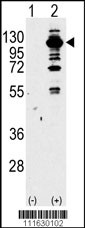
Western blot analysis of PI3KCG Antibody (Center) Pab (arrow) using purified Pab. 293 cell lysates (2 ug/lane) either nontransfected (Lane 1) or transiently transfected with the PI3KCG gene (Lane 2) (Origene Technologies).Application
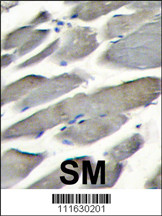
Formalin-fixed and paraffin-embedded skeletal muscle tissue reacted with PI3KCG antibody (Center), which was peroxidase-conjugated to the secondary antibody, followed by DAB staining. This data demonstrates the use of this antibody for immunohistochemistry; clinical relevance has not been evaluated.| Product Name | PI3KCG Antibody (Center) |
|---|---|
| Antibody Type | Primary Antibodies |
| Antigen Alias | PIK3CG; Phosphatidylinositol 4, 5-bisphosphate 3-kinase catalytic subunit gamma isoform; Phosphatidylinositol 4, 5-bisphosphate 3-kinase 110 kDa catalytic subunit gamma; Phosphoinositide-3-kinase catalytic gamma polypeptide; Serine/threonine protein kinase |
| Clonality | Polyclonal |
|---|---|
| Isotype | Ig |
| Host Species | Rabbit |
| Tested Applications | WBIHC |
| WB:1:100~500 IHC |
|
| Species Reactivity | Human |
| Concentration | 1mg/ml |
| Alternative Names | PIK3CG Phosphatidylinositol 4 5-bisphosphate 3-kinase catalytic subunit gamma isoform Phosphatidylinositol 4 5-bisphosphate 3-kinase 110 kDa catalytic subunit gamma Phosphoinositide-3-kinase catalytic gamma polypeptide Serine/threonine protein kinase |
|---|---|
| Molecular Weight(MW) | 126454 Da |
| Function | Phosphoinositide-3-kinase (PI3K) that phosphorylates PtdIns(4,5)P2 (Phosphatidylinositol 4,5-bisphosphate) to generate phosphatidylinositol 3,4,5-trisphosphate (PIP3). PIP3 plays a key role by recruiting PH domain-containing proteins to the membrane, including AKT1 and PDPK1, activating signaling cascades involved in cell growth, survival, proliferation, motility and morphology Links G-protein coupled receptor activation to PIP3 production Involved in immune, inflammatory and allergic responses. Modulates leukocyte chemotaxis to inflammatory sites and in response to chemoattractant agents. May control leukocyte polarization and migration by regulating the spatial accumulation of PIP3 and by regulating the organization of F-actin formation and integrin- based adhesion at the leading edge. Controls motility of dendritic cells. Together with PIK3CD is involved in natural killer (NK) cell development and migration towards the sites of inflammation Participates in T-lymphocyte migration. Regulates T-lymphocyte proliferation and cytokine production. Together with PIK3CD participates in T-lymphocyte development. Required for B- lymphocyte development and signaling. Together with PIK3CD participates in neutrophil respiratory burst. Together with PIK3CD is involved in neutrophil chemotaxis and extravasation. Together with PIK3CB promotes platelet aggregation and thrombosis Regulates alpha-IIb/beta-3 integrins (ITGA2B/ ITGB3) adhesive function in platelets downstream of P2Y12 through a lipid kinase activity-independent mechanism. May have also a lipid kinase activity-dependent function in platelet aggregation. Involved in endothelial progenitor cell migration. Negative regulator of cardiac contractility. Modulates cardiac contractility by anchoring protein kinase A (PKA) and PDE3B activation, reducing cAMP levels. Regulates cardiac contractility also by promoting beta-adrenergic receptor internalization by binding to ADRBK1 and by non-muscle tropomyosin phosphorylation. Also has serine/threonine protein kinase activity: both lipid and protein kinase activities are required for beta-adrenergic receptor endocytosis. May also have a scaffolding role in modulating cardiac contractility. Contributes to cardiac hypertrophy under pathological stress. Through simultaneous binding of PDE3B to RAPGEF3 and PIK3R6 is assembled in a signaling complex in which the PI3K gamma complex is activated by RAPGEF3 and which is involved in angiogenesis |
| Tissue Specificity | Pancreas, skeletal muscle, liver and heart. |
| Cellular Localization | Cytoplasm. Cell membrane. |
| Entrez Gene | 5294 |
|---|
Application
Western blot analysis of PI3KCG Antibody (Center) Pab (arrow) using purified Pab. 293 cell lysates (2 ug/lane) either nontransfected (Lane 1) or transiently transfected with the PI3KCG gene (Lane 2) (Origene Technologies).
Application
Formalin-fixed and paraffin-embedded skeletal muscle tissue reacted with PI3KCG antibody (Center), which was peroxidase-conjugated to the secondary antibody, followed by DAB staining. This data demonstrates the use of this antibody for immunohistochemistry; clinical relevance has not been evaluated.| Application Notes | WB:1:100~500 IHC |
|---|
| Form | Liquid |
|---|---|
| Storage Instructions | For short-term storage, store at 4° C. For long-term storage, aliquot and store at -20ºC or below. Avoid multiple freeze-thaw cycles. |
| Storage Buffer | Purified polyclonal antibody supplied in PBS with 0.09% (W/V) sodium azide. This antibody is purified through a protein A column, eluted with high and low pH buffers and neutralized immediately, followed by dialysis against PBS. |


