Application
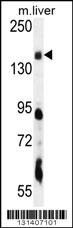
PIK3C2A Antibody (C-term) western blot analysis in mouse liver tissue lysates (35ug/lane).This demonstrates the PIK3C2A antibody detected the PIK3C2A protein (arrow).Application
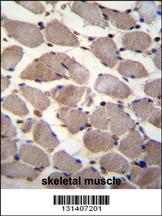
PIK3C2A Antibody (C-term) immunohistochemistry analysis in formalin fixed and paraffin embedded human skeletal muscle followed by peroxidase conjugation of the secondary antibody and DAB staining.This data demonstrates the use of PIK3C2A Antibody (C-term) for immunohistochemistry. Clinical relevance has not been evaluated.| Product Name | PIK3C2A Antibody (C-term) |
|---|---|
| Antibody Type | Primary Antibodies |
| Antigen Alias | PIK3C2A; Phosphatidylinositol 4-phosphate 3-kinase C2 domain-containing subunit alpha; Phosphoinositide 3-kinase-C2-alpha |
| Clonality | Polyclonal |
|---|---|
| Isotype | Ig |
| Host Species | Rabbit |
| Tested Applications | WBIHC |
| WB:1:100~500 IHC |
|
| Species Reactivity | Human |
| Concentration | 1mg/ml |
| Alternative Names | PIK3C2A Phosphatidylinositol 4-phosphate 3-kinase C2 domain-containing subunit alpha Phosphoinositide 3-kinase-C2-alpha |
|---|---|
| Molecular Weight(MW) | 190680 Da |
| Function | Generates phosphatidylinositol 3-phosphate (PtdIns3P) and phosphatidylinositol 3,4-bisphosphate (PtdIns(3,4)P2) that act as second messengers. Has a role in several intracellular trafficking events. Functions in insulin signaling and secretion Required for translocation of the glucose transporter SLC2A4/GLUT4 to the plasma membrane and glucose uptake in response to insulin- mediated RHOQ activation. Regulates insulin secretion through two different mechanisms: involved in glucose-induced insulin secretion downstream of insulin receptor in a pathway that involves AKT1 activation and TBC1D4/AS160 phosphorylation, and participates in the late step of insulin granule exocytosis probably in insulin granule fusion. Synthesizes PtdIns3P in response to insulin signaling. Functions in clathrin-coated endocytic vesicle formation and distribution. Regulates dynamin- independent endocytosis, probably by recruiting EEA1 to internalizing vesicles. In neurosecretory cells synthesizes PtdIns3P on large dense core vesicles. Participates in calcium induced contraction of vascular smooth muscle by regulating myosin light chain (MLC) phosphorylation through a mechanism involving Rho kinase-dependent phosphorylation of the MLCP-regulatory subunit MYPT1. May play a role in the EGF signaling cascade. May be involved in mitosis and UV-induced damage response. Required for maintenance of normal renal structure and function by supporting normal podocyte function |
| Tissue Specificity | Expressed in columnar and transitional epithelia, mononuclear cells, smooth muscle cells, and endothelial cells lining capillaries and small venules (at protein level) Ubiquitously expressed, with highest levels in heart, placenta and ovary, and lowest levels in the kidney. Detected at low levels in islets of Langerhans from type 2 diabetes mellitus individuals |
| Cellular Localization | Cell membrane. Golgi apparatus. Cytoplasmic vesicle, clathrin-coated vesicle. Nucleus. Cytoplasm Note=According to PubMed:10766823 and PubMed:11239472, it is found in the cell membrane, the Golgi apparatus and in clathrin-coated vesicles. According to PubMed:17038310 it inserts preferentially into membranes containing PtdIns(4,5)P2. According to PubMed:11606566, it is nuclear and cytoplasmic. Associated with RNA-containing structures. According to PubMed:14563213, it is mainly cytoplasmic |
| Entrez Gene | 5286 |
|---|---|
| Nucleotide Accession | NP_002636.2 |
Application
PIK3C2A Antibody (C-term) western blot analysis in mouse liver tissue lysates (35ug/lane).This demonstrates the PIK3C2A antibody detected the PIK3C2A protein (arrow).
Application
PIK3C2A Antibody (C-term) immunohistochemistry analysis in formalin fixed and paraffin embedded human skeletal muscle followed by peroxidase conjugation of the secondary antibody and DAB staining.This data demonstrates the use of PIK3C2A Antibody (C-term) for immunohistochemistry. Clinical relevance has not been evaluated.| Application Notes | WB:1:100~500 IHC |
|---|
| Form | Liquid |
|---|---|
| Storage Instructions | For short-term storage, store at 4° C. For long-term storage, aliquot and store at -20ºC or below. Avoid multiple freeze-thaw cycles. |
| Storage Buffer | Purified polyclonal antibody supplied in PBS with 0.09% (W/V) sodium azide. This antibody is purified through a protein A column, followed by peptide affinity purification. |


