Application
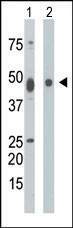
The anti-PIP5K3 Pab is used in Western blot to detect PIP5K2A in mouse brain tissue lysate (Lane 1) and HL-60 cell lysate (Lane 2).| Product Name | PIP5K2A Antibody (C-term) |
|---|---|
| Antibody Type | Primary Antibodies |
| Antigen Alias | PIP4K2A; PIP5K2; PIP5K2A; Phosphatidylinositol 5-phosphate 4-kinase type-2 alpha; 1-phosphatidylinositol 5-phosphate 4-kinase 2-alpha; Diphosphoinositide kinase 2-alpha; PIP5KIII; Phosphatidylinositol 5-phosphate 4-kinase type II alpha; PtdIns(4)P-5-kinase |
| Clonality | Polyclonal |
|---|---|
| Isotype | Ig |
| Host Species | Rabbit |
| Tested Applications | WB |
| WB:1:100~500 |
|
| Species Reactivity | Human |
| Concentration | 1mg/ml |
| Gene Synonyms | PIP5K2 PIP5K2A |
|---|---|
| Alternative Names | PIP4K2A PIP5K2 PIP5K2A Phosphatidylinositol 5-phosphate 4-kinase type-2 alpha 1-phosphatidylinositol 5-phosphate 4-kinase 2-alpha Diphosphoinositide kinase 2-alpha PIP5KIII Phosphatidylinositol 5-phosphate 4-kinase type II alpha PtdIns(4)P-5-kinase |
| Molecular Weight(MW) | 46225 Da |
| Function | Catalyzes the phosphorylation of phosphatidylinositol 5- phosphate (PtdIns5P) on the fourth hydroxyl of the myo-inositol ring, to form phosphatidylinositol 4,5-bisphosphate (PtdIns(4,5)P2). May exert its function by regulating the levels of PtdIns5P, which functions in the cytosol by increasing AKT activity and in the nucleus signals through ING2. May regulate the pool of cytosolic PtdIns5P in response to the activation of tyrosine phosphorylation. May negatively regulate insulin- stimulated glucose uptake by lowering the levels of PtdIns5P. May be involved in thrombopoiesis, and the terminal maturation of megakaryocytes and regulation of their size |
| Tissue Specificity | Expressed ubiquitously, with high levels in the brain. Present in most tissues, except notably skeletal muscle and small intestine |
| Cellular Localization | Cell membrane (By similarity). Nucleus. Cytoplasm. Note=May translocate from the cytosol to the cell membrane upon activation of tyrosine phosphorylation. May translocate from the inner to the outer segments of the rod photoreceptor cells in response to light (By similarity) Localization to the nucleus is modulated by the interaction with PIP4K2B |
Application
The anti-PIP5K3 Pab is used in Western blot to detect PIP5K2A in mouse brain tissue lysate (Lane 1) and HL-60 cell lysate (Lane 2).| Application Notes | WB:1:100~500 |
|---|
| Form | Liquid |
|---|---|
| Storage Instructions | For short-term storage, store at 4° C. For long-term storage, aliquot and store at -20ºC or below. Avoid multiple freeze-thaw cycles. |
| Storage Buffer | Purified polyclonal antibody supplied in PBS with 0.09% (W/V) sodium azide. This antibody is purified through a protein G column, eluted with high and low pH buffers and neutralized immediately, followed by dialysis against PBS. |


