Application
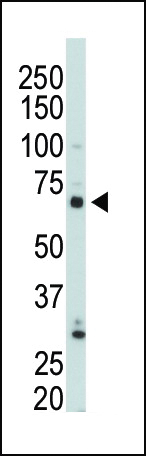
The anti-PIP5K1G Pab is used in Western blot to detect PIP5K1G in 293 cell lysate.| Product Name | PIP5KI gamma (PIP5K1G) Antibody (N-term) |
|---|---|
| Antibody Type | Primary Antibodies |
| Antigen Alias | PIP5K1C; KIAA0589; Phosphatidylinositol 4-phosphate 5-kinase type-1 gamma; Phosphatidylinositol 4-phosphate 5-kinase type I gamma |
| Clonality | Polyclonal |
|---|---|
| Isotype | Ig |
| Host Species | Rabbit |
| Tested Applications | WB |
| WB:1:100~500 |
|
| Species Reactivity | Human |
| Concentration | 1mg/ml |
| Gene Synonyms | KIAA0589 |
|---|---|
| Alternative Names | PIP5K1C KIAA0589 Phosphatidylinositol 4-phosphate 5-kinase type-1 gamma Phosphatidylinositol 4-phosphate 5-kinase type I gamma |
| Molecular Weight(MW) | 73260 Da |
| Function | Catalyzes the phosphorylation of phosphatidylinositol 4- phosphate (PtdIns4P) to form phosphatidylinositol 4,5-bisphosphate (PtdIns(4,5)P2). PtdIns(4,5)P2 is involved in a variety of cellular processes and is the substrate to form phosphatidylinositol 3,4,5-trisphosphate (PtdIns(3,4,5)P3), another second messenger. The majority of PtdIns(4,5)P2 is thought to occur via type I phosphatidylinositol 4-phosphate 5-kinases given the abundance of PtdIns4P. Participates in a variety of cellular processes such as vesicle mediated transport, cell adhesion, cell polarization and cell migration. Together with PIP5K1A is required for phagocytosis, but they regulate different types of actin remodeling at sequential steps. Promotes particle attachment by generating the pool of PtdIns(4,5)P2 that induces controlled actin depolymerization to facilitate Fc-gamma-R clustering. Mediates RAC1-dependent reorganization of actin filaments. Required for synaptic vesicle transport. Controls the plasma membrane pool of PtdIns(4,5)P2 implicated in synaptic vesicle endocytosis and exocytosis. Plays a role in endocytosis mediated by clathrin and AP-2 (adaptor protein complex 2) Required for clathrin-coated pits assembly at the synapse Participates in cell junction assembly. Modulates adherens junctions formation by facilitating CDH1 trafficking. Required for focal adhesion dynamics. Modulates the targeting of talins (TLN1 and TLN2) to the plasma membrane and their efficient assembly into focal adhesions. Regulates the interaction between talins (TLN1 and TLN2) and beta-integrins. Required for uropodium formation and retraction of the cell rear during directed migration. Has a role in growth factor- stimulated directional cell migration and adhesion. Required for talin assembly into nascent adhesions forming at the leading edge toward the direction of the growth factor. Negative regulator of T-cell activation and adhesion Negatively regulates integrin alpha-L/beta-2 (LFA-1) polarization and adhesion induced by T-cell receptor. Together with PIP5K1A have a role during embryogenesis and together with PIP5K1B may have a role immediately after birth |
| Tissue Specificity | Isoform 1 is strongly expressed in brain and also detected in heart and lung. Isoform 2 is strongly expressed in pancreas and liver and in lesser quantities in brain, heart, lung and kidney. Isoform 3 is detected in large amounts in heart and large intestine, is also present in lung, pancreas and thyroid, and to a lesser extent in brain, stomach and kidney |
| Cellular Localization | Cell membrane; Peripheral membrane protein; Cytoplasmic side. Endomembrane system. Cytoplasm. Cell junction, focal adhesion. Cell junction, adherens junction. Cell projection, ruffle membrane. Cell projection, phagocytic cup. Cell projection, uropodium. Note=Detected in plasma membrane invaginations. Isoform 3 is detected in intracellular vesicle-like structures |
| Entrez Gene | 23396 |
|---|
Application
The anti-PIP5K1G Pab is used in Western blot to detect PIP5K1G in 293 cell lysate.| Application Notes | WB:1:100~500 |
|---|
| Form | Liquid |
|---|---|
| Storage Instructions | For short-term storage, store at 4° C. For long-term storage, aliquot and store at -20ºC or below. Avoid multiple freeze-thaw cycles. |
| Storage Buffer | Purified polyclonal antibody supplied in PBS with 0.09% (W/V) sodium azide. This antibody is purified through a protein G column, eluted with high and low pH buffers and neutralized immediately, followed by dialysis against PBS. |


