Application
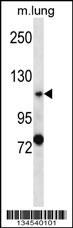
PKD2 Antibody (C-term) western blot analysis in mouse lung tissue lysates (35ug/lane).This demonstrates the PKD2 antibody detected the PKD2 protein (arrow).| Product Name | PKD2 Antibody (C-term) |
|---|---|
| Antibody Type | Primary Antibodies |
| Antigen Alias | PKD2; Polycystin-2; Autosomal dominant polycystic kidney disease type II protein; Polycystic kidney disease 2 protein; Polycystwin; R48321 |
| Clonality | Polyclonal |
|---|---|
| Isotype | Ig |
| Host Species | Rabbit |
| Tested Applications | WB |
| WB:1:100~500 |
|
| Species Reactivity | Human |
| Concentration | 1mg/ml |
| Alternative Names | PKD2 Polycystin-2 Autosomal dominant polycystic kidney disease type II protein Polycystic kidney disease 2 protein Polycystwin R48321 |
|---|---|
| Molecular Weight(MW) | 109691 Da |
| Function | Involved in fluid-flow mechanosensation by the primary cilium in renal epithelium (By similarity). PKD1 and PKD2 may function through a common signaling pathway that is necessary for normal tubulogenesis (By similarity). Acts as a regulator of cilium length, together with PKD1 (By similarity). The dynamic control of cilium length is essential in the regulation of mechanotransductive signaling. The cilium length response creates a negative feedback loop whereby fluid shear-mediated deflection of the primary cilium, which decreases intracellular cAMP, leads to cilium shortening and thus decreases flow-induced signaling (By similarity). Functions as a calcium permeable cation channel |
| Tissue Specificity | Strongly expressed in ovary, fetal and adult kidney, testis, and small intestine. Not detected in peripheral leukocytes |
| Cellular Localization | Membrane; Multi-pass membrane protein (Potential). Endoplasmic reticulum. Cell projection, cilium (By similarity) |
| Entrez Gene | 5311 |
|---|---|
| Nucleotide Accession | NP_000288.1 |
Application
PKD2 Antibody (C-term) western blot analysis in mouse lung tissue lysates (35ug/lane).This demonstrates the PKD2 antibody detected the PKD2 protein (arrow).| Application Notes | WB:1:100~500 |
|---|
| Form | Liquid |
|---|---|
| Storage Instructions | For short-term storage, store at 4° C. For long-term storage, aliquot and store at -20ºC or below. Avoid multiple freeze-thaw cycles. |
| Storage Buffer | Purified polyclonal antibody supplied in PBS with 0.09% (W/V) sodium azide. This antibody is purified through a protein A column, followed by peptide affinity purification. |


