Application
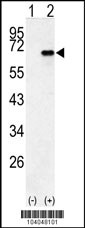
Western blot analysis of PRKR (arrow) using rabbit polyclonal PKR (PRKR) Antibody (C-term T535) . 293 cell lysates (2 ug/lane) either nontransfected (Lane 1) or transiently transfected with the PRKR gene (Lane 2) (Origene Technologies).| Product Name | PKR (PRKR) Antibody (C-term T535) |
|---|---|
| Antibody Type | Primary Antibodies |
| Antigen Alias | EIF2AK2; PKR; PRKR; Interferon-induced, double-stranded RNA-activated protein kinase; Eukaryotic translation initiation factor 2-alpha kinase 2; Interferon-inducible RNA-dependent protein kinase; P1/eIF-2A protein kinase; Protein kinase RNA-activated; Tyr |
| Clonality | Polyclonal |
|---|---|
| Isotype | Ig |
| Host Species | Rabbit |
| Tested Applications | WB |
| WB:1:100~500 |
|
| Species Reactivity | Human |
| Concentration | 1mg/ml |
| Gene Synonyms | PKR PRKR |
|---|---|
| Alternative Names | EIF2AK2 PKR PRKR Interferon-induced double-stranded RNA-activated protein kinase Eukaryotic translation initiation factor 2-alpha kinase 2 Interferon-inducible RNA-dependent protein kinase P1/eIF-2A protein kinase Protein kinase RNA-activated Tyr |
| Molecular Weight(MW) | 62094 Da |
| Function | Following activation by double-stranded RNA in the presence of ATP, the kinase becomes autophosphorylated and can catalyze the phosphorylation of the translation initiation factor EIF2S1, which leads to an inhibition of the initiation of protein synthesis. Double-stranded RNA is generated during the course of a viral infection. In addition to serine/threonine-protein kinase activity, also has tyrosine-protein kinase activity: phosphorylates CDK1 upon DNA damage. CDK1 phosphorylation triggers CDK1 polyubiquitination and subsequent proteolysis, thus leading to G2 arrest |
| Tissue Specificity | This PKR (PRKR) antibody is generated from rabbits immunized with a KLH conjugated synthetic peptide between 522~551 amino acids from the C-terminal region of human PRKR. |
Application
Western blot analysis of PRKR (arrow) using rabbit polyclonal PKR (PRKR) Antibody (C-term T535) . 293 cell lysates (2 ug/lane) either nontransfected (Lane 1) or transiently transfected with the PRKR gene (Lane 2) (Origene Technologies).| Application Notes | WB:1:100~500 |
|---|
| Form | Liquid |
|---|---|
| Storage Instructions | For short-term storage, store at 4° C. For long-term storage, aliquot and store at -20ºC or below. Avoid multiple freeze-thaw cycles. |
| Storage Buffer | Purified polyclonal antibody supplied in PBS with 0.09% (W/V) sodium azide. This antibody is prepared by Saturated Ammonium Sulfate (SAS) precipitation followed by dialysis against PBS. |


