Application
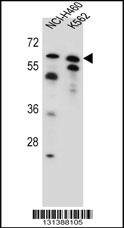
PLAG1 Antibody (N-term) western blot analysis in NCI-H460,K562 cell line lysates (35ug/lane).This demonstrates the PLAG1 antibody detected the PLAG1 protein (arrow).| Product Name | PLAG1 Antibody (N-term) |
|---|---|
| Antibody Type | Primary Antibodies |
| Antigen Alias | PLAG1; Zinc finger protein PLAG1; Pleiomorphic adenoma gene 1 protein |
| Clonality | Polyclonal |
|---|---|
| Isotype | Ig |
| Host Species | Rabbit |
| Tested Applications | WB |
| WB:1:100~500 |
|
| Species Reactivity | Human |
| Concentration | 1mg/ml |
| Alternative Names | PLAG1 Zinc finger protein PLAG1 Pleiomorphic adenoma gene 1 protein |
|---|---|
| Molecular Weight(MW) | 55909 Da |
| Function | Transcription factor whose activation results in up- regulation of target genes, such as IGFII, leading to uncontrolled cell proliferation: when overexpressed in cultured cells, higher proliferation rate and transformation are observed. Other target genes such as CRLF1, CRABP2, CRIP2, PIGF are strongly induced in cells with PLAG1 induction. Proto-oncogene whose ectopic expression can trigger the development of pleomorphic adenomas of the salivary gland and lipoblastomas. Overexpression is associated with up-regulation of IGFII, is frequently observed in hepatoblastoma, common primary liver tumor in childhood Cooperates with CBFB-MYH11, a fusion gene important for myeloid leukemia |
| Tissue Specificity | Expressed in fetal tissues such as lung, liver and kidney. Not detected or weak detection in normal adult tissues, but highly expressed in salivary gland with benign or malignant pleiomorphic adenomas with or without 8q12 abberations, with preferential occurrence in benign tumors |
| Cellular Localization | Nucleus. Note=Strong nucleolar localization when sumoylation is inhibited |
| Entrez Gene | 5324 |
|---|---|
| Nucleotide Accession | NP_001108106.1 NP_002646.2 |
Application
PLAG1 Antibody (N-term) western blot analysis in NCI-H460,K562 cell line lysates (35ug/lane).This demonstrates the PLAG1 antibody detected the PLAG1 protein (arrow).| Application Notes | WB:1:100~500 |
|---|
| Form | Liquid |
|---|---|
| Storage Instructions | For short-term storage, store at 4° C. For long-term storage, aliquot and store at -20ºC or below. Avoid multiple freeze-thaw cycles. |
| Storage Buffer | Purified polyclonal antibody supplied in PBS with 0.09% (W/V) sodium azide. This antibody is purified through a protein A column, followed by peptide affinity purification. |


