Application
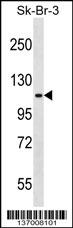
PLCD4 Antibody (C-term) western blot analysis in SK-BR-3 cell line lysates (35ug/lane).This demonstrates the PLCD4 antibody detected the PLCD4 protein (arrow).| Product Name | PLCD4 Antibody (C-term) |
|---|---|
| Antibody Type | Primary Antibodies |
| Antigen Alias | PLCD4; 1-phosphatidylinositol 4, 5-bisphosphate phosphodiesterase delta-4; Phosphoinositide phospholipase C-delta-4; Phospholipase C-delta-4 |
| Clonality | Polyclonal |
|---|---|
| Isotype | Ig |
| Host Species | Rabbit |
| Tested Applications | WB |
| WB:1:100~500 |
|
| Species Reactivity | Human |
| Concentration | 1mg/ml |
| Alternative Names | PLCD4 1-phosphatidylinositol 4 5-bisphosphate phosphodiesterase delta-4 Phosphoinositide phospholipase C-delta-4 Phospholipase C-delta-4 |
|---|---|
| Molecular Weight(MW) | 87585 Da |
| Function | Hydrolyzes the phosphatidylinositol 4,5-bisphosphate (PIP2) to generate 2 second messenger molecules diacylglycerol (DAG) and inositol 1,4,5-trisphosphate (IP3). DAG mediates the activation of protein kinase C (PKC), while IP3 releases Ca(2+) from intracellular stores. Required for acrosome reaction in sperm during fertilization, probably by acting as an important enzyme for intracellular Ca(2+) mobilization in the zona pellucida- induced acrosome reaction. May play a role in cell growth Modulates the liver regeneration in cooperation with nuclear PKC Overexpression up-regulates the Erk signaling pathway and proliferation |
| Tissue Specificity | Highly expressed in skeletal muscle and kidney tissues, and at moderate level in intestinal tissue. Expressed in corneal epithelial cells |
| Cellular Localization | Membrane; Peripheral membrane protein (By similarity). Nucleus (By similarity). Cytoplasm. Endoplasmic reticulum (By similarity). Note=Localizes primarily to intracellular membranes mostly to the endoplasmic reticulum |
| Entrez Gene | 84812 |
|---|---|
| Nucleotide Accession | NP_116115.1 |
Application
PLCD4 Antibody (C-term) western blot analysis in SK-BR-3 cell line lysates (35ug/lane).This demonstrates the PLCD4 antibody detected the PLCD4 protein (arrow).| Application Notes | WB:1:100~500 |
|---|
| Form | Liquid |
|---|---|
| Storage Instructions | For short-term storage, store at 4° C. For long-term storage, aliquot and store at -20ºC or below. Avoid multiple freeze-thaw cycles. |
| Storage Buffer | Purified polyclonal antibody supplied in PBS with 0.09% (W/V) sodium azide. This antibody is purified through a protein A column, followed by peptide affinity purification. |


