Application
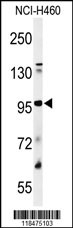
Western blot analysis of PLG Antibody (N-term) in NCI-H460 cell line lysates (35ug/lane). PLG (arrow) was detected using the purified Pab.| Product Name | PLG Antibody (N-term) |
|---|---|
| Antibody Type | Primary Antibodies |
| Antigen Alias | PLG; Plasminogen; Plasmin heavy chain A; Activation peptide; Angiostatin; Plasmin heavy chain A, short form; Plasmin light chain B |
| Clonality | Polyclonal |
|---|---|
| Isotype | Ig |
| Host Species | Rabbit |
| Tested Applications | WB |
| WB:1:50~100 |
|
| Species Reactivity | Human |
| Concentration | 1mg/ml |
| Alternative Names | PLG Plasminogen Plasmin heavy chain A Activation peptide Angiostatin Plasmin heavy chain A short form Plasmin light chain B |
|---|---|
| Molecular Weight(MW) | 90569 Da |
| Function | Plasmin dissolves the fibrin of blood clots and acts as a proteolytic factor in a variety of other processes including embryonic development, tissue remodeling, tumor invasion, and inflammation. In ovulation, weakens the walls of the Graafian follicle. It activates the urokinase-type plasminogen activator, collagenases and several complement zymogens, such as C1 and C5 Cleavage of fibronectin and laminin leads to cell detachment and apoptosis. Also cleaves fibrin, thrombospondin and von Willebrand factor. Its role in tissue remodeling and tumor invasion may be modulated by CSPG4. Binds to cells |
| Tissue Specificity | Present in plasma and many other extracellular fluids. It is synthesized in the liver |
| Cellular Localization | Secreted. Note=Locates to the cell surface where it is proteolytically cleaved to produce the active plasmin Interaction with HRG tethers it to the cell surface |
| Entrez Gene | 5340 |
|---|
Application
Western blot analysis of PLG Antibody (N-term) in NCI-H460 cell line lysates (35ug/lane). PLG (arrow) was detected using the purified Pab.| Application Notes | WB:1:50~100 |
|---|
| Form | Liquid |
|---|---|
| Storage Instructions | For short-term storage, store at 4° C. For long-term storage, aliquot and store at -20ºC or below. Avoid multiple freeze-thaw cycles. |
| Storage Buffer | Purified polyclonal antibody supplied in PBS with 0.09% (W/V) sodium azide. This antibody is prepared by Saturated Ammonium Sulfate (SAS) precipitation followed by dialysis against PBS. |


