Application
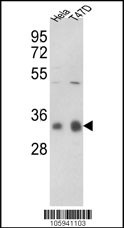
Western blot analysis of hPPP1CC-A306 in Hela, T47D cell line lysates (35ug/lane).PPP1CC (arrow) was detected using the purified Pab.| Product Name | PP1C gamma (PPP1CC) Antibody (C-term) |
|---|---|
| Antibody Type | Primary Antibodies |
| Antigen Alias | PPP1CC; Serine/threonine-protein phosphatase PP1-gamma catalytic subunit; Protein phosphatase 1C catalytic subunit |
| Clonality | Polyclonal |
|---|---|
| Isotype | Ig |
| Host Species | Rabbit |
| Tested Applications | WB |
| WB:1:100~500 |
|
| Species Reactivity | Human |
| Concentration | 1mg/ml |
| Alternative Names | PPP1CC Serine/threonine-protein phosphatase PP1-gamma catalytic subunit Protein phosphatase 1C catalytic subunit |
|---|---|
| Molecular Weight(MW) | 36984 Da |
| Function | Protein phosphatase that associates with over 200 regulatory proteins to form highly specific holoenzymes which dephosphorylate hundreds of biological targets. Protein phosphatase 1 (PP1) is essential for cell division, and participates in the regulation of glycogen metabolism, muscle contractility and protein synthesis. Dephosphorylates RPS6KB1 Involved in regulation of ionic conductances and long-term synaptic plasticity. May play an important role in dephosphorylating substrates such as the postsynaptic density- associated Ca(2+)/calmodulin dependent protein kinase II Component of the PTW/PP1 phosphatase complex, which plays a role in the control of chromatin structure and cell cycle progression during the transition from mitosis into interphase |
| Tissue Specificity | This PPP1CC antibody is generated from rabbits immunized with a KLH conjugated synthetic peptide between 294~323 amino acids from the C-terminal region of human PPP1CC. |
| Cellular Localization | Cytoplasm. Nucleus. Nucleus, nucleolus. Nucleus, nucleoplasm. Nucleus speckle. Chromosome, centromere, kinetochore. Cleavage furrow. Midbody. Mitochondrion Note=Colocalizes with SPZ1 in the nucleus (By similarity) Colocalizes with URI1 at mitochondrion. Rapidly exchanges between the nucleolar, nucleoplasmic and cytoplasmic compartments. Highly mobile in cells and can be relocalized through interaction with targeting subunits. In the presence of PPP1R8 relocalizes from the nucleolus to nuclear speckles. Shows a dynamic targeting to specific sites throughout the cell cycle. Highly concentrated in nucleoli of interphase cells and localizes at kinetochores early in mitosis. Relocalization to chromosome-containing regions occurs at the transition from early to late anaphase. Also accumulates at the cleavage furrow and midbody by telophase |
| Entrez Gene | 5501 |
|---|
Application
Western blot analysis of hPPP1CC-A306 in Hela, T47D cell line lysates (35ug/lane).PPP1CC (arrow) was detected using the purified Pab.| Application Notes | WB:1:100~500 |
|---|
| Form | Liquid |
|---|---|
| Storage Instructions | For short-term storage, store at 4° C. For long-term storage, aliquot and store at -20ºC or below. Avoid multiple freeze-thaw cycles. |
| Storage Buffer | Purified polyclonal antibody supplied in PBS with 0.09% (W/V) sodium azide. This antibody is purified through a protein G column, eluted with high and low pH buffers and neutralized immediately, followed by dialysis against PBS. |


