Application
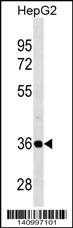
PSMD14 Antibody (C-term) western blot analysis in HepG2 cell line lysates (35ug/lane).This demonstrates the PSMD14 antibody detected the PSMD14 protein (arrow).| Product Name | PSMD14 Antibody (C-term) |
|---|---|
| Antibody Type | Primary Antibodies |
| Antigen Alias | PSMD14; POH1; 26S proteasome non-ATPase regulatory subunit 14; 26S proteasome regulatory subunit RPN11; 26S proteasome-associated PAD1 homolog 1 |
| Clonality | Polyclonal |
|---|---|
| Isotype | Ig |
| Host Species | Rabbit |
| Tested Applications | WB |
| WB:1:100~500 |
|
| Species Reactivity | Human |
| Concentration | 1mg/ml |
| Gene Synonyms | POH1 |
|---|---|
| Alternative Names | PSMD14 POH1 26S proteasome non-ATPase regulatory subunit 14 26S proteasome regulatory subunit RPN11 26S proteasome-associated PAD1 homolog 1 |
| Molecular Weight(MW) | 34577 Da |
| Function | Metalloprotease component of the 26S proteasome that specifically cleaves 'Lys-63'-linked polyubiquitin chains. The 26S proteasome is involved in the ATP-dependent degradation of ubiquitinated proteins. Plays a role in response to double-strand breaks (DSBs): acts as a regulator of non-homologous end joining (NHEJ) by cleaving 'Lys-63'-linked polyubiquitin, thereby promoting retention of JMJD2A/KDM4A on chromatin and restricting TP53BP1 accumulation. Also involved in homologous recombination repair by promoting RAD51 loading |
| Tissue Specificity | Widely expressed. Highest levels in heart and skeletal muscle |
| Entrez Gene | 10213 |
|---|---|
| Nucleotide Accession | NP_005796.1 |
Application
PSMD14 Antibody (C-term) western blot analysis in HepG2 cell line lysates (35ug/lane).This demonstrates the PSMD14 antibody detected the PSMD14 protein (arrow).| Application Notes | WB:1:100~500 |
|---|
| Form | Liquid |
|---|---|
| Storage Instructions | For short-term storage, store at 4° C. For long-term storage, aliquot and store at -20ºC or below. Avoid multiple freeze-thaw cycles. |
| Storage Buffer | Purified polyclonal antibody supplied in PBS with 0.09% (W/V) sodium azide. This antibody is purified through a protein A column, followed by peptide affinity purification. |


