Application
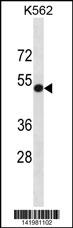
PVR Antibody (C-term) western blot analysis in K562 cell line lysates (35ug/lane).This demonstrates the PVR antibody detected the PVR protein (arrow).| Product Name | PVR Antibody (C-term) |
|---|---|
| Antibody Type | Primary Antibodies |
| Clonality | Polyclonal |
|---|---|
| Isotype | Ig |
| Host Species | Rabbit |
| Tested Applications | WB |
| WB:1:100~500 |
|
| Species Reactivity | Human |
| Concentration | 1mg/ml |
| Gene Synonyms | PVS |
|---|---|
| Alternative Names | PVR PVS Poliovirus receptor Nectin-like protein 5 CD_antigen=CD155 Flags: Precursor |
| Molecular Weight(MW) | 45303 Da |
| Function | Mediates NK cell adhesion and triggers NK cell effector functions. Binds two different NK cell receptors: CD96 and CD226 These interactions accumulates at the cell-cell contact site, leading to the formation of a mature immunological synapse between NK cell and target cell. This may trigger adhesion and secretion of lytic granules and IFN-gamma and activate cytoxicity of activated NK cells. May also promote NK cell-target cell modular exchange, and PVR transfer to the NK cell. This transfer is more important in some tumor cells expressing a lot of PVR, and may trigger fratricide NK cell activation, providing tumors with a mechanism of immunoevasion. Plays a role in mediating tumor cell invasion and migration. Serves as a receptor for poliovirus attachment to target cells. May play a role in axonal transport of poliovirus, by targeting virion-PVR-containing endocytic vesicles to the microtubular network through interaction with DYNLT1. This interaction would drive the virus-containing vesicle to the axonal retrograde transport |
| Tissue Specificity | This PVR antibody is generated from rabbits immunized with a KLH conjugated synthetic peptide between 314-342 amino acids from the C-terminal region of human PVR. |
| Cellular Localization | Isoform Alpha: Cell membrane; Single-pass type I membrane protein Isoform Beta: Secreted. |
| Entrez Gene | 5817 |
|---|---|
| Nucleotide Accession | NP_006496.3 |
Application
PVR Antibody (C-term) western blot analysis in K562 cell line lysates (35ug/lane).This demonstrates the PVR antibody detected the PVR protein (arrow).| Application Notes | WB:1:100~500 |
|---|
| Form | Liquid |
|---|---|
| Storage Instructions | For short-term storage, store at 4° C. For long-term storage, aliquot and store at -20ºC or below. Avoid multiple freeze-thaw cycles. |
| Storage Buffer | Purified polyclonal antibody supplied in PBS with 0.09% (W/V) sodium azide. This antibody is purified through a protein A column, followed by peptide affinity purification. |


