Application
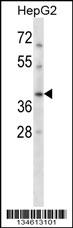
RAD51C Antibody (Center) western blot analysis in HepG2 cell line lysates (35ug/lane).This demonstrates the RAD51C antibody detected the RAD51C protein (arrow).| Product Name | RAD51C Antibody (Center) |
|---|---|
| Antibody Type | Primary Antibodies |
| Antigen Alias | RAD51C; RAD51L2; DNA repair protein RAD51 homolog 3; RAD51 homolog C; RAD51-like protein 2 |
| Clonality | Polyclonal |
|---|---|
| Isotype | Ig |
| Host Species | Rabbit |
| Tested Applications | WB |
| WB:1:100~500 |
|
| Species Reactivity | Human |
| Concentration | 1mg/ml |
| Gene Synonyms | RAD51L2 |
|---|---|
| Alternative Names | RAD51C RAD51L2 DNA repair protein RAD51 homolog 3 RAD51 homolog C RAD51-like protein 2 |
| Molecular Weight(MW) | 42190 Da |
| Function | Essential for the homologous recombination (HR) pathway of DNA repair. Involved in the homologous recombination repair (HRR) pathway of double-stranded DNA breaks arising during DNA replication or induced by DNA-damaging agents. The RAD51B-RAD51C dimer exhibits single-stranded DNA-dependent ATPase activity. The BCDX2 complex binds single-stranded DNA, single-stranded gaps in duplex DNA and specifically to nicks in duplex DNA. Participates in branch migration and Holliday junction resolution and thus is important for processing HR intermediates late in the DNA repair process. Also has an early function in DNA repair in facilitating phosphorylation of the checkpoint kinase CHEK2 and thereby transduction of the damage signal, leading to cell cycle arrest and HR activation. Protects RAD51 from ubiquitin-mediated degradation that is enhanced following DNA damage. Plays a role in regulating mitochondrial DNA copy number under conditions of oxidative stress in the presence of RAD51 and XRCC3. Contributes to DNA cross-link resistance, sister chromatid cohesion and genomic stability. Involved in maintaining centrosome number in mitosis |
| Tissue Specificity | Expressed in a variety of tissues, with highest expression in testis, heart muscle, spleen and prostate |
| Cellular Localization | Nucleus. Cytoplasm. Cytoplasm, perinuclear region. Mitochondrion. Note=DNA damage induces an increase in nuclear levels. Accumulates in DNA damage induced nuclear foci or RAD51C foci which is formed during the S or G2 phase of cell cycle. Accumulation at DNA lesions requires the presence of NBN/NBS1, ATM and RPA |
| Entrez Gene | 5889 |
|---|---|
| Nucleotide Accession | NP_478123.1 NP_002867.1 |
Application
RAD51C Antibody (Center) western blot analysis in HepG2 cell line lysates (35ug/lane).This demonstrates the RAD51C antibody detected the RAD51C protein (arrow).| Application Notes | WB:1:100~500 |
|---|
| Form | Liquid |
|---|---|
| Storage Instructions | For short-term storage, store at 4° C. For long-term storage, aliquot and store at -20ºC or below. Avoid multiple freeze-thaw cycles. |
| Storage Buffer | Purified polyclonal antibody supplied in PBS with 0.09% (W/V) sodium azide. This antibody is purified through a protein A column, followed by peptide affinity purification. |


