Application
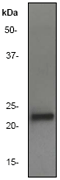
A. Western blot analysis on HL60 cell lysate using anti-Rho RabMAb (Cat. #AJ1688a), dilution 1:10,000.Application
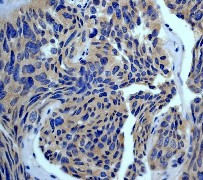
B. Immunohistochemical analysis of paraffin-embedded human prostate carcinoma using anti-Rho RabMAb (Cat. #AJ1688a).| Product Name | Rho Antibody |
|---|---|
| Antibody Type | Primary Antibodies |
| Clonality | Monoclonal |
|---|---|
| Clone Number | EP487Y |
| Host Species | Rabbit |
| Tested Applications | WBIHC |
| WB:1:5000~50000 IHC |
|
| Species Reactivity | Human |
| Concentration | 1mg/ml |
| Gene Synonyms | ARH12, ARHA, RHO12 |
|---|---|
| Alternative Names | RHOA ARH12 ARHA RHO12 Transforming protein RhoA H12 |
| Molecular Weight(MW) | 21768 Da |
| Function | Regulates a signal transduction pathway linking plasma membrane receptors to the assembly of focal adhesions and actin stress fibers. Involved in a microtubule-dependent signal that is required for the myosin contractile ring formation during cell cycle cytokinesis. Plays an essential role in cleavage furrow formation. Required for the apical junction formation of keratinocyte cell-cell adhesion. Serves as a target for the yopT cysteine peptidase from Yersinia pestis, vector of the plague, and Yersinia pseudotuberculosis, which causes gastrointestinal disorders. Stimulates PKN2 kinase activity. May be an activator of PLCE1. Activated by ARHGEF2, which promotes the exchange of GDP for GTP. Essential for the SPATA13-mediated regulation of cell migration and adhesion assembly and disassembly. The MEMO1-RHOA- DIAPH1 signaling pathway plays an important role in ERBB2- dependent stabilization of microtubules at the cell cortex. It controls the localization of APC and CLASP2 to the cell membrane, via the regulation of GSK3B activity. In turn, membrane-bound APC allows the localization of the MACF1 to the cell membrane, which is required for microtubule capture and stabilization |
| Tissue Specificity | A synthetic peptide corresponding to residues near the N-term of human Rho was used as immunogen. The antibody is predicted to detect RhoA, RhoB and RhoC based on sequence analysis. |
| Cellular Localization | Cell membrane; Lipid-anchor; Cytoplasmic side. Cytoplasm, cytoskeleton. Cleavage furrow. Cytoplasm, cell cortex. Midbody. Note=Localized to cell-cell contacts in calcium- treated keratinocytes (By similarity). Translocates to the equatorial region before furrow formation in a ECT2-dependent manner. Localizes to the equatorial cell cortex (at the site of the presumptive furrow) in early anaphase in a activated form and in a myosin- and actin-independent manner |
| Entrez Gene | 387 |
|---|
Application
A. Western blot analysis on HL60 cell lysate using anti-Rho RabMAb (Cat. #AJ1688a), dilution 1:10,000.
Application
B. Immunohistochemical analysis of paraffin-embedded human prostate carcinoma using anti-Rho RabMAb (Cat. #AJ1688a).| Application Notes | WB:1:5000~50000 IHC |
|---|
| Form | Liquid |
|---|---|
| Storage Instructions | For short-term storage, store at 4° C. For long-term storage, aliquot and store at -20ºC or below. Avoid multiple freeze-thaw cycles. |
| Storage Buffer | 50 mM Tris-Glycine (pH 7.4), 0.15 M NaCl, 40% Glycerol, 0.01% sodium azide and 0.05% BSA. |


