Application
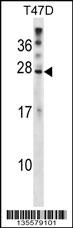
RNF4 Antibody (C-term) western blot analysis in T47D cell line lysates (35ug/lane).This demonstrates the RNF4 antibody detected the RNF4 protein (arrow).| Product Name | RNF4 Antibody (C-term) |
|---|---|
| Antibody Type | Primary Antibodies |
| Antigen Alias | RNF4; SNURF; E3 ubiquitin-protein ligase RNF4; RING finger protein 4; Small nuclear ring finger protein |
| Clonality | Polyclonal |
|---|---|
| Isotype | Ig |
| Host Species | Rabbit |
| Tested Applications | WB |
| WB:1:100~500 |
|
| Species Reactivity | Human |
| Concentration | 1mg/ml |
| Gene Synonyms | SNURF |
|---|---|
| Alternative Names | RNF4 SNURF E3 ubiquitin-protein ligase RNF4 RING finger protein 4 Small nuclear ring finger protein |
| Molecular Weight(MW) | 21319 Da |
| Function | E3 ubiquitin-protein ligase which binds polysumoylated chains covalently attached to proteins and mediates 'Lys-6'-, 'Lys-11'-, 'Lys-48'- and 'Lys-63'-linked polyubiquitination of those substrates and their subsequent targeting to the proteasome for degradation. Regulates the degradation of several proteins including PML and the transcriptional activator PEA3. Involved in chromosome alignment and spindle assembly, it regulates the kinetochore CENPH-CENPI-CENPK complex by targeting polysumoylated CENPI to proteasomal degradation. Regulates the cellular responses to hypoxia and heat shock through degradation of respectively EPAS1 and PARP1. Alternatively, it may also bind DNA/nucleosomes and have a more direct role in the regulation of transcription for instance enhancing basal transcription and steroid receptor- mediated transcriptional activation |
| Tissue Specificity | Widely expressed at low levels in many tissues; highly expressed in testis |
| Cellular Localization | Cytoplasm. Nucleus. Nucleus, PML body. Nucleus, nucleoplasm |
| Entrez Gene | 6047 |
|---|---|
| Nucleotide Accession | NP_001171939.1 NP_001171938.1 |
Application
RNF4 Antibody (C-term) western blot analysis in T47D cell line lysates (35ug/lane).This demonstrates the RNF4 antibody detected the RNF4 protein (arrow).| Application Notes | WB:1:100~500 |
|---|
| Form | Liquid |
|---|---|
| Storage Instructions | For short-term storage, store at 4° C. For long-term storage, aliquot and store at -20ºC or below. Avoid multiple freeze-thaw cycles. |
| Storage Buffer | Purified polyclonal antibody supplied in PBS with 0.09% (W/V) sodium azide. This antibody is purified through a protein A column, followed by peptide affinity purification. |


