Application
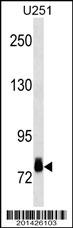
RPS6KA3 Antibody (Cat. #AM2008b) western blot analysis in U251 cell line lysates (35ug/lane).This demonstrates the RPS6KA3 antibody detected the RPS6KA3 protein (arrow).| Product Name | RPS6KA3 Antibody |
|---|---|
| Antibody Type | Primary Antibodies |
| Antigen Alias | RPS6KA3; ISPK1; MAPKAPK1B; RSK2; Ribosomal protein S6 kinase alpha-3; 90 kDa ribosomal protein S6 kinase 3; Insulin-stimulated protein kinase 1; MAP kinase-activated protein kinase 1b; Ribosomal S6 kinase 2; pp90RSK2 |
| Clonality | Monoclonal |
|---|---|
| Isotype | IgG1 |
| Clone Number | 356CT10.6.1.2 |
| Host Species | Mouse |
| Tested Applications | WB |
| WB:1:100~500 |
|
| Species Reactivity | Human |
| Concentration | 1mg/ml |
| Gene Synonyms | ISPK1 MAPKAPK1B RSK2 |
|---|---|
| Alternative Names | RPS6KA3 ISPK1 MAPKAPK1B RSK2 Ribosomal protein S6 kinase alpha-3 90 kDa ribosomal protein S6 kinase 3 Insulin-stimulated protein kinase 1 MAP kinase-activated protein kinase 1b Ribosomal S6 kinase 2 pp90RSK2 |
| Molecular Weight(MW) | 83736 Da |
| Function | Serine/threonine-protein kinase that acts downstream of ERK (MAPK1/ERK2 and MAPK3/ERK1) signaling and mediates mitogenic and stress-induced activation of the transcription factors CREB1, ETV1/ER81 and NR4A1/NUR77, regulates translation through RPS6 and EIF4B phosphorylation, and mediates cellular proliferation, survival, and differentiation by modulating mTOR signaling and repressing pro-apoptotic function of BAD and DAPK1. In fibroblast, is required for EGF-stimulated phosphorylation of CREB1 and histone H3 at 'Ser-10', which results in the subsequent transcriptional activation of several immediate-early genes. In response to mitogenic stimulation (EGF and PMA), phosphorylates and activates NR4A1/NUR77 and ETV1/ER81 transcription factors and the cofactor CREBBP. Upon insulin-derived signal, acts indirectly on the transcription regulation of several genes by phosphorylating GSK3B at 'Ser-9' and inhibiting its activity Phosphorylates RPS6 in response to serum or EGF via an mTOR- independent mechanism and promotes translation initiation by facilitating assembly of the preinitiation complex. In response to insulin, phosphorylates EIF4B, enhancing EIF4B affinity for the EIF3 complex and stimulating cap-dependent translation. Is involved in the mTOR nutrient-sensing pathway by directly phosphorylating TSC2 at 'Ser-1798', which potently inhibits TSC2 ability to suppress mTOR signaling, and mediates phosphorylation of RPTOR, which regulates mTORC1 activity and may promote rapamycin-sensitive signaling independently of the PI3K/AKT pathway. Mediates cell survival by phosphorylating the pro- apoptotic proteins BAD and DAPK1 and suppressing their pro- apoptotic function. Promotes the survival of hepatic stellate cells by phosphorylating CEBPB in response to the hepatotoxin carbon tetrachloride (CCl4). Is involved in cell cycle regulation by phosphorylating the CDK inhibitor CDKN1B, which promotes CDKN1B association with 14-3-3 proteins and prevents its translocation to the nucleus and inhibition of G1 progression. In LPS-stimulated dendritic cells, is involved in TLR4-induced macropinocytosis, and in myeloma cells, acts as effector of FGFR3-mediated transformation signaling, after direct phosphorylation at Tyr-529 by FGFR3. Phosphorylates DAPK1 |
| Tissue Specificity | Expressed in many tissues, highest levels in skeletal muscle |
| Cellular Localization | Nucleus (By similarity). Cytoplasm (By similarity) |
| Entrez Gene | 6197 |
|---|---|
| Nucleotide Accession | NP_004577.1 |
Application
RPS6KA3 Antibody (Cat. #AM2008b) western blot analysis in U251 cell line lysates (35ug/lane).This demonstrates the RPS6KA3 antibody detected the RPS6KA3 protein (arrow).| Application Notes | WB:1:100~500 |
|---|
| Form | Liquid |
|---|---|
| Storage Instructions | For short-term storage, store at 4° C. For long-term storage, aliquot and store at -20ºC or below. Avoid multiple freeze-thaw cycles. |
| Storage Buffer | Purified monoclonal antibody supplied in PBS with 0.09% (W/V) sodium azide. This antibody is prepared by Saturated Ammonium Sulfate (SAS) precipitation followed by dialysis against PBS. |


