Application
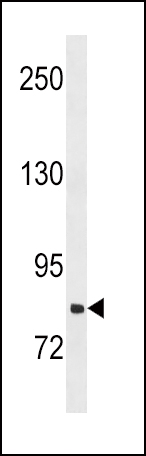
SLCO1B3 Antibody (C-term) western blot analysis in NCI-H460 cell line lysates (35ug/lane).This demonstrates the SLCO1B3 antibody detected the SLCO1B3 protein (arrow).| Product Name | SLCO1B3 Antibody (C-term) |
|---|---|
| Antibody Type | Primary Antibodies |
| Antigen Alias | SLCO1B3; LST2; OATP1B3; OATP8; SLC21A8; Solute carrier organic anion transporter family member 1B3; Liver-specific organic anion transporter 2; Organic anion transporter 8; Organic anion-transporting polypeptide 8; Solute carrier family 21 member 8 |
| Clonality | Polyclonal |
|---|---|
| Isotype | Ig |
| Host Species | Rabbit |
| Tested Applications | WB |
| WB:1:100~500 |
|
| Species Reactivity | Human |
| Concentration | 1mg/ml |
| Gene Synonyms | LST2 OATP1B3 OATP8 SLC21A8 |
|---|---|
| Alternative Names | SLCO1B3 LST2 OATP1B3 OATP8 SLC21A8 Solute carrier organic anion transporter family member 1B3 Liver-specific organic anion transporter 2 Organic anion transporter 8 Organic anion-transporting polypeptide 8 Solute carrier family 21 member 8 |
| Molecular Weight(MW) | 77403 Da |
| Function | Mediates the Na(+)-independent uptake of organic anions such as 17-beta-glucuronosyl estradiol, taurocholate, triiodothyronine (T3), leukotriene C4, dehydroepiandrosterone sulfate (DHEAS), methotrexate and sulfobromophthalein (BSP) Involved in the clearance of bile acids and organic anions from the liver |
| Tissue Specificity | Highly expressed in liver, in particular at the basolateral membrane of hepatocytes near the central vein. Not detected in other tissues. Highly expressed in some cancer cell lines derived from colon, pancreas, liver and gall bladder |
| Cellular Localization | Basolateral cell membrane; Multi-pass membrane protein |
| Entrez Gene | 28234 |
|---|---|
| Nucleotide Accession | NP_062818.1 |
Application
SLCO1B3 Antibody (C-term) western blot analysis in NCI-H460 cell line lysates (35ug/lane).This demonstrates the SLCO1B3 antibody detected the SLCO1B3 protein (arrow).| Application Notes | WB:1:100~500 |
|---|
| Form | Liquid |
|---|---|
| Storage Instructions | For short-term storage, store at 4° C. For long-term storage, aliquot and store at -20ºC or below. Avoid multiple freeze-thaw cycles. |
| Storage Buffer | Purified polyclonal antibody supplied in PBS with 0.09% (W/V) sodium azide. This antibody is purified through a protein A column, followed by peptide affinity purification. |


