Application
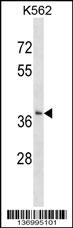
SMUG1 Antibody (N-term) western blot analysis in K562 cell line lysates (35ug/lane).This demonstrates the SMUG1 antibody detected the SMUG1 protein (arrow).| Product Name | SMUG1 Antibody (N-term) |
|---|---|
| Antibody Type | Primary Antibodies |
| Antigen Alias | SMUG1; Single-strand selective monofunctional uracil DNA glycosylase |
| Clonality | Polyclonal |
|---|---|
| Isotype | Ig |
| Host Species | Rabbit |
| Tested Applications | WB |
| WB:1:100~500 |
|
| Species Reactivity | Human |
| Concentration | 1mg/ml |
| Alternative Names | SMUG1 Single-strand selective monofunctional uracil DNA glycosylase |
|---|---|
| Molecular Weight(MW) | 29862 Da |
| Function | Responsible for recognizing base lesions in the genome and initiating base excision DNA repair. Acts as a monofunctional DNA glycosylase specific for uracil (U) residues in DNA and has a preference for single-stranded DNA substrates. The activity is greater against mismatches (U/G) than against matches (U/A) Excised uracil (U), 5-formyluracil (fU) and uracil derivatives bearing an oxidized group at C5 [5-hydroxyuracil (hoU) and 5- hydroxymethyluracil (hmU)] in ssDNA and dsDNA but not analogous cytosine derivatives (5-hydroxycytosine and 5-formylcytosine) and other oxidized damage. The activity is damage specificity and salt concentration-dependent. The general order of the preference for ssDNA and dsDNA is the following: ssDNA > dsDNA (G pair) = dsDNA (A pair) at the low salt concentration. At the high concentration dsDNA (G pair) > dsDNA (A pair) > ssDNA |
| Tissue Specificity | This SMUG1 antibody is generated from rabbits immunized with a KLH conjugated synthetic peptide between 42-71 amino acids from the N-terminal region of human SMUG1. |
| Cellular Localization | Nucleus. |
| Entrez Gene | 23583 |
|---|---|
| Nucleotide Accession | NP_055126.1 |
Application
SMUG1 Antibody (N-term) western blot analysis in K562 cell line lysates (35ug/lane).This demonstrates the SMUG1 antibody detected the SMUG1 protein (arrow).| Application Notes | WB:1:100~500 |
|---|
| Form | Liquid |
|---|---|
| Storage Instructions | For short-term storage, store at 4° C. For long-term storage, aliquot and store at -20ºC or below. Avoid multiple freeze-thaw cycles. |
| Storage Buffer | Purified polyclonal antibody supplied in PBS with 0.09% (W/V) sodium azide. This antibody is purified through a protein A column, followed by peptide affinity purification. |


