Application
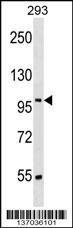
SRRT Antibody (N-term) western blot analysis in 293 cell line lysates (35ug/lane).This demonstrates the SRRT antibody detected the SRRT protein (arrow).| Product Name | SRRT Antibody (N-term) |
|---|---|
| Antibody Type | Primary Antibodies |
| Antigen Alias | SRRT; ARS2; ASR2; Serrate RNA effector molecule homolog; Arsenite-resistance protein 2 |
| Clonality | Polyclonal |
|---|---|
| Isotype | Ig |
| Host Species | Rabbit |
| Tested Applications | WB |
| WB:1:100~500 |
|
| Species Reactivity | Human |
| Concentration | 1mg/ml |
| Gene Synonyms | ARS2 ASR2 |
|---|---|
| Alternative Names | SRRT ARS2 ASR2 Serrate RNA effector molecule homolog Arsenite-resistance protein 2 |
| Molecular Weight(MW) | 100666 Da |
| Function | Acts as a mediator between the cap-binding complex (CBC) and the primary microRNAs (miRNAs) processing machinery during cell proliferation. Contributes to the stability and delivery of capped primary miRNA transcripts to the primary miRNA processing complex containing DGCR8 and DROSHA, thereby playing a role in RNA-mediated gene silencing (RNAi) by miRNAs. Binds capped RNAs (m7GpppG-capped RNA); however interaction is probably mediated via its interaction with NCBP1/CBP80 component of the CBC complex Involved in cell cycle progression at S phase. Does not directly confer arsenite resistance but rather modulates arsenic sensitivity. Independently of its activity on miRNAs, necessary and sufficient to promote neural stem cell self-renewal. Does so by directly binding SOX2 promoter and positively regulating its transcription (By similarity) |
| Tissue Specificity | Ubiquitously expressed. |
| Cellular Localization | Nucleus, nucleoplasm (By similarity). Cytoplasm (By similarity). Note=Predominantly nuclear. Shuttles between the nucleus and the cytoplasm in a CRM1-dependent way (By similarity) |
| Entrez Gene | 51593 |
|---|---|
| Nucleotide Accession | NP_001122325.1 NP_001122324.1 |
Application
SRRT Antibody (N-term) western blot analysis in 293 cell line lysates (35ug/lane).This demonstrates the SRRT antibody detected the SRRT protein (arrow).| Application Notes | WB:1:100~500 |
|---|
| Form | Liquid |
|---|---|
| Storage Instructions | For short-term storage, store at 4° C. For long-term storage, aliquot and store at -20ºC or below. Avoid multiple freeze-thaw cycles. |
| Storage Buffer | Purified polyclonal antibody supplied in PBS with 0.09% (W/V) sodium azide. This antibody is purified through a protein A column, followed by peptide affinity purification. |


