Application
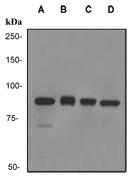
Western blot analysis on (A) HeLa (B) 293 (C) NIH-3T3 (D) A431 cell lysates using anti-Stat-1 RabMAb (Cat. #AJ1737a).| Product Name | Stat-1 Antibody |
|---|---|
| Antibody Type | Primary Antibodies |
| Antigen Alias | STAT1, Signal transducer and activator of transcription 1-alpha/beta, Transcription factor ISGF-3 components p91/p84 |
| Clonality | Monoclonal |
|---|---|
| Clone Number | EPYR2154 |
| Host Species | Rabbit |
| Tested Applications | WB |
| WB:1:1000~2000 |
|
| Species Reactivity | Human |
| Concentration | 1mg/ml |
| Alternative Names | STAT1 Signal transducer and activator of transcription 1-alpha/beta Transcription factor ISGF-3 components p91/p84 |
|---|---|
| Molecular Weight(MW) | 87335 Da |
| Function | Signal transducer and transcription activator that mediates cellular responses to interferons (IFNs), cytokine KITLG/SCF and other cytokines and growth factors. Following type I IFN (IFN-alpha and IFN-beta) binding to cell surface receptors, signaling via protein kinases leads to activation of Jak kinases (TYK2 and JAK1) and to tyrosine phosphorylation of STAT1 and STAT2. The phosphorylated STATs dimerize, associate with ISGF3G/IRF-9 to form a complex termed ISGF3 transcription factor, that enters the nucleus. ISGF3 binds to the IFN stimulated response element (ISRE) to activate the transcription of interferon stimulated genes, which drive the cell in an antiviral state. In response to type II IFN (IFN-gamma), STAT1 is tyrosine- and serine-phosphorylated. It then forms a homodimer termed IFN- gamma-activated factor (GAF), migrates into the nucleus and binds to the IFN gamma activated sequence (GAS) to drive the expression of the target genes, inducing a cellular antiviral state. Becomes activated in response to KITLG/SCF and KIT signaling. May mediate cellular responses to activated FGFR1, FGFR2, FGFR3 and FGFR4 |
| Tissue Specificity | A synthetic peptide corresponding to residues in human Stat-1 was used as an immunogen. |
| Cellular Localization | Cytoplasm. Nucleus. Note=Translocated into the nucleus upon tyrosine phosphorylation and dimerization, in response to IFN-gamma and signaling by activated FGFR1, FGFR2, FGFR3 or FGFR4 |
| Entrez Gene | 6772 |
|---|
Application
Western blot analysis on (A) HeLa (B) 293 (C) NIH-3T3 (D) A431 cell lysates using anti-Stat-1 RabMAb (Cat. #AJ1737a).| Application Notes | WB:1:1000~2000 |
|---|
| Form | Liquid |
|---|---|
| Storage Instructions | For short-term storage, store at 4° C. For long-term storage, aliquot and store at -20ºC or below. Avoid multiple freeze-thaw cycles. |
| Storage Buffer | 50 mM Tris-Glycine (pH 7.4), 0.15 M NaCl, 40% Glycerol, 0.01% sodium azide and 0.05% BSA. |


