Application
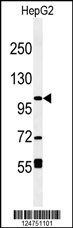
Western blot analysis of STT3B Antibody (C-term) in HepG2 cell line lysates (35ug/lane). STT3B (arrow) was detected using the purified Pab.Application
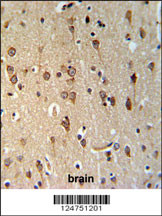
STT3B Antibody (C-term) IHC analysis in formalin fixed and paraffin embedded brain tissue followed by peroxidase conjugation of the secondary antibody and DAB staining. This data demonstrates the use of the STT3B Antibody (C-term) for immunohistochemistry. Clinical relevance has not been evaluated.Application
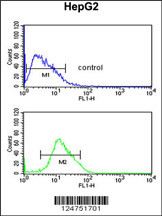
STT3B Antibody (C-term) flow cytometric analysis of HepG2 cells (bottom histogram) compared to a negative control cell (top histogram).FITC-conjugated goat-anti-rabbit secondary antibodies were used for the analysis.| Product Name | STT3B Antibody (C-term) |
|---|---|
| Antibody Type | Primary Antibodies |
| Antigen Alias | STT3B; SIMP; Dolichyl-diphosphooligosaccharide--protein glycosyltransferase subunit STT3B; Source of immunodominant MHC-associated peptides homolog |
| Clonality | Polyclonal |
|---|---|
| Isotype | Ig |
| Host Species | Rabbit |
| Tested Applications | WBIHCFC |
| WB:1:100~500 IHC |
|
| Species Reactivity | Human |
| Concentration | 1mg/ml |
| Gene Synonyms | SIMP |
|---|---|
| Alternative Names | STT3B SIMP Dolichyl-diphosphooligosaccharide--protein glycosyltransferase subunit STT3B Source of immunodominant MHC-associated peptides homolog |
| Molecular Weight(MW) | 93674 Da |
| Function | Catalytic subunit of the N-oligosaccharyl transferase (OST) complex which catalyzes the transfer of a high mannose oligosaccharide from a lipid-linked oligosaccharide donor to an asparagine residue within an Asn-X-Ser/Thr consensus motif in nascent polypeptide chains. N-glycosylation occurs cotranslationally and the complex associates with the Sec61 complex at the channel-forming translocon complex that mediates protein translocation across the endoplasmic reticulum (ER). STT3B is present in a small subset of OST complexes and mediates both cotranslational and post-translational N-glycosylation of target proteins: STT3B-containing complexes are required for efficient cotranslational glycosylation and while they are less competent than STT3A-containing complexes for cotranslational glycosylation, they have the ability to mediate glycosylation of some nascent sites that are not accessible for STT3A. STT3B-containing complexes also act post-translationally and mediate modification of skipped glycosylation sites in unfolded proteins. Plays a role in ER-associated degradation (ERAD) pathway that mediates ubiquitin-dependent degradation of misfolded endoplasmic reticulum proteins by mediating N-glycosylation of unfolded proteins, which are then recognized by the ERAD pathway and targeted for degradation. Mediates glycosylation of the disease variant AMYL- TTR 'Asp-38' of TTR at 'Asn-118', leading to its degradation |
| Tissue Specificity | Expressed in heart, brain, placenta, lung, liver, muscle, kidney and pancreas. Expressed in skin fibroblasts (at protein level) |
| Cellular Localization | Endoplasmic reticulum membrane; Multi-pass membrane protein |
| Entrez Gene | 201595 |
|---|
Application
Western blot analysis of STT3B Antibody (C-term) in HepG2 cell line lysates (35ug/lane). STT3B (arrow) was detected using the purified Pab.
Application
STT3B Antibody (C-term) IHC analysis in formalin fixed and paraffin embedded brain tissue followed by peroxidase conjugation of the secondary antibody and DAB staining. This data demonstrates the use of the STT3B Antibody (C-term) for immunohistochemistry. Clinical relevance has not been evaluated.
Application
STT3B Antibody (C-term) flow cytometric analysis of HepG2 cells (bottom histogram) compared to a negative control cell (top histogram).FITC-conjugated goat-anti-rabbit secondary antibodies were used for the analysis.| Application Notes | WB:1:100~500 IHC |
|---|
| Form | Liquid |
|---|---|
| Storage Instructions | For short-term storage, store at 4° C. For long-term storage, aliquot and store at -20ºC or below. Avoid multiple freeze-thaw cycles. |
| Storage Buffer | Purified polyclonal antibody supplied in PBS with 0.09% (W/V) sodium azide. This antibody is purified through a protein A column, followed by peptide affinity purification. |


