Application
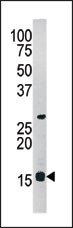
Western blot analysis of anti-TrX Pab in HepG2 cell line lysate (35ug/lane). TrX(arrow) was detected using the purified Pab (1:63 dilution).| Product Name | Thioredoxin (TRX) Antibody (C-term) |
|---|---|
| Antibody Type | Primary Antibodies |
| Clonality | Polyclonal |
|---|---|
| Isotype | Ig |
| Host Species | Rabbit |
| Tested Applications | WB |
| WB:1:100~500 |
|
| Species Reactivity | Human |
| Concentration | 1mg/ml |
| Gene Synonyms | TRDX, TRX, TRX1 |
|---|---|
| Alternative Names | Thioredoxin TXN |
| Molecular Weight(MW) | 11737 Da |
| Function | Participates in various redox reactions through the reversible oxidation of its active center dithiol to a disulfide and catalyzes dithiol-disulfide exchange reactions. Plays a role in the reversible S-nitrosylation of cysteine residues in target proteins, and thereby contributes to the response to intracellular nitric oxide. Nitrosylates the active site Cys of CASP3 in response to nitric oxide (NO), and thereby inhibits caspase-3 activity. Induces the FOS/JUN AP-1 DNA-binding activity in ionizing radiation (IR) cells through its oxidation/reduction status and stimulates AP-1 transcriptional activity |
| Tissue Specificity | This TRX antibody is generated from rabbits immunized with a KLH conjugated synthetic peptide selected from amino acids 75-105 of human TrX. |
| Cellular Localization | Nucleus. Cytoplasm. Secreted. Note=Secreted by a leaderless secretory pathway. Predominantly in the cytoplasm in non irradiated cells. Radiation induces translocation of TRX from the cytoplasm to the nucleus |
Application
Western blot analysis of anti-TrX Pab in HepG2 cell line lysate (35ug/lane). TrX(arrow) was detected using the purified Pab (1:63 dilution).| Application Notes | WB:1:100~500 |
|---|
| Form | Liquid |
|---|---|
| Storage Instructions | For short-term storage, store at 4° C. For long-term storage, aliquot and store at -20ºC or below. Avoid multiple freeze-thaw cycles. |
| Storage Buffer | Purified polyclonal antibody supplied in PBS with 0.09% (W/V) sodium azide. This antibody is purified through a protein G column, eluted with high and low pH buffers and neutralized immediately, followed by dialysis against PBS. |


