Application
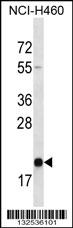
TMED2 Antibody (N-term) western blot analysis in NCI-H460 cell line lysates (35ug/lane).This demonstrates the TMED2 antibody detected the TMED2 protein (arrow).Application
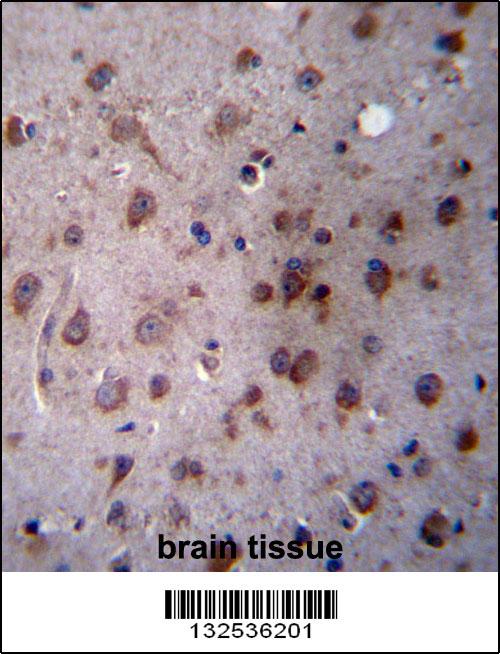
TMED2 Antibody (N-term) immunohistochemistry analysis in formalin fixed and paraffin embedded human brain tissue followed by peroxidase conjugation of the secondary antibody and DAB staining.This data demonstrates the use of TMED2 Antibody (N-term) for immunohistochemistry. Clinical relevance has not been evaluated.| Product Name | TMED2 Antibody (N-term) |
|---|---|
| Antibody Type | Primary Antibodies |
| Clonality | Polyclonal |
|---|---|
| Isotype | Ig |
| Host Species | Rabbit |
| Tested Applications | WBIHC |
| WB:1:100~500 IHC |
|
| Species Reactivity | Human |
| Concentration | 1mg/ml |
| Gene Synonyms | RNP24 |
|---|---|
| Alternative Names | TMED2 RNP24 Transmembrane emp24 domain-containing protein 2 Membrane protein p24A p24 p24 family protein beta-1 |
| Molecular Weight(MW) | 22761 Da |
| Function | Involved in vesicular protein trafficking. Mainly functions in the early secretory pathway but also in post-Golgi membranes. Thought to act as cargo receptor at the lumenal side for incorporation of secretory cargo molecules into transport vesicles and to be involved in vesicle coat formation at the cytoplasmic side. In COPII vesicle-mediated anterograde transport involved in the transport of GPI-anchored proteins and proposed to act togther with TMED10 as their cargo receptor; the function specifically implies SEC24C and SEC24D of the COPII vesicle coat and lipid raft-like microdomains of the ER. Recognizes GPI anchors structural remodeled in the ER by PGAP1 and MPPE1. In COPI vesicle-mediated retrograde transport inhibits the GTPase- activating activity of ARFGAP1 towards ARF1 thus preventing immature uncoating and allowing cargo selection to take place Involved in trafficking of G protein-coupled receptors (GPCRs) Regulates F2RL1, OPRM1 and P2RY4 exocytic trafficking from the Golgi to the plasma membrane thus contributing to receptor resensitization. Facilitates CASR maturation and stabilization in the early secretory pathway and increases CASR plasma membrane targeting. Proposed to be involved in organization of intracellular membranes such as the maintenance of the Golgi apparatus. May also play a role in the biosynthesis of secreted cargo such as eventual processing |
| Tissue Specificity | This TMED2 antibody is generated from rabbits immunized with a KLH conjugated synthetic peptide between 49-79 amino acids from the N-terminal region of human TMED2. |
| Cellular Localization | Cytoplasmic vesicle membrane; Single-pass type I membrane protein. Cytoplasmic vesicle, COPI-coated vesicle membrane; Single-pass type I membrane protein. Golgi apparatus, cis-Golgi network membrane; Single-pass type I membrane protein Golgi apparatus, Golgi stack membrane; Single-pass type I membrane protein. Endoplasmic reticulum membrane; Single-pass type I membrane protein. Endoplasmic reticulum-Golgi intermediate compartment membrane; Single-pass type I membrane protein Note=Cycles between compartments of the early secretatory pathway |
| Entrez Gene | 10959 |
|---|---|
| Nucleotide Accession | NP_006806.1 |
Application
TMED2 Antibody (N-term) western blot analysis in NCI-H460 cell line lysates (35ug/lane).This demonstrates the TMED2 antibody detected the TMED2 protein (arrow).
Application
TMED2 Antibody (N-term) immunohistochemistry analysis in formalin fixed and paraffin embedded human brain tissue followed by peroxidase conjugation of the secondary antibody and DAB staining.This data demonstrates the use of TMED2 Antibody (N-term) for immunohistochemistry. Clinical relevance has not been evaluated.| Application Notes | WB:1:100~500 IHC |
|---|
| Form | Liquid |
|---|---|
| Storage Instructions | For short-term storage, store at 4° C. For long-term storage, aliquot and store at -20ºC or below. Avoid multiple freeze-thaw cycles. |
| Storage Buffer | Purified polyclonal antibody supplied in PBS with 0.09% (W/V) sodium azide. This antibody is purified through a protein A column, followed by peptide affinity purification. |


