Application
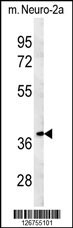
TNFAIP1 Antibody (C-term) western blot analysis in mouse Neuro-2a cell line lysates (35ug/lane).This demonstrates the TNFAIP1 antibody detected the TNFAIP1 protein (arrow).| Product Name | TNFAIP1 Antibody (C-term) |
|---|---|
| Antibody Type | Primary Antibodies |
| Antigen Alias | TNFAIP1; BACURD2; EDP1; BTB/POZ domain-containing adapter for CUL3-mediated RhoA degradation protein 2; BTB/POZ domain-containing protein TNFAIP1; Protein B12; Tumor necrosis factor, alpha-induced protein 1, endothelial |
| Clonality | Polyclonal |
|---|---|
| Isotype | Ig |
| Host Species | Rabbit |
| Tested Applications | WB |
| WB:1:100~500 |
|
| Species Reactivity | Human |
| Concentration | 1mg/ml |
| Gene Synonyms | BACURD2 EDP1 |
|---|---|
| Alternative Names | TNFAIP1 BACURD2 EDP1 BTB/POZ domain-containing adapter for CUL3-mediated RhoA degradation protein 2 BTB/POZ domain-containing protein TNFAIP1 Protein B12 Tumor necrosis factor alpha-induced protein 1 endothelial |
| Molecular Weight(MW) | 36204 Da |
| Function | Substrate-specific adapter of a BCR (BTB-CUL3-RBX1) E3 ubiquitin-protein ligase complex involved in regulation of cytoskeleton structure. The BCR(BACURD2) E3 ubiquitin ligase complex mediates the ubiquitination of RHOA, leading to its degradation by the proteasome, thereby regulating the actin cytoskeleton and cell migration. Its interaction with RHOB may regulate apoptosis. May enhance the PCNA-dependent DNA polymerase delta activity |
| Tissue Specificity | This TNFAIP1 antibody is generated from rabbits immunized with a KLH conjugated synthetic peptide between 295-324 amino acids from the C-terminal region of human TNFAIP1. |
| Cellular Localization | Cytoplasm. Nucleus. Endosome. Note=Colocalizes with RHOB in endosomes |
| Entrez Gene | 7126 |
|---|---|
| Nucleotide Accession | NP_066960.1 |
Application
TNFAIP1 Antibody (C-term) western blot analysis in mouse Neuro-2a cell line lysates (35ug/lane).This demonstrates the TNFAIP1 antibody detected the TNFAIP1 protein (arrow).| Application Notes | WB:1:100~500 |
|---|
| Form | Liquid |
|---|---|
| Storage Instructions | For short-term storage, store at 4° C. For long-term storage, aliquot and store at -20ºC or below. Avoid multiple freeze-thaw cycles. |
| Storage Buffer | Purified polyclonal antibody supplied in PBS with 0.09% (W/V) sodium azide. This antibody is purified through a protein A column, followed by peptide affinity purification. |


