Application
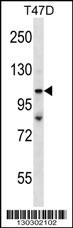
TP53BP2 Antibody (N-term) western blot analysis in T47D cell line lysates (35ug/lane).This demonstrates the TP53BP2 antibody detected the TP53BP2 protein (arrow).| Product Name | TP53BP2 Antibody (N-term) |
|---|---|
| Antibody Type | Primary Antibodies |
| Antigen Alias | TP53BP2; ASPP2; BBP; Apoptosis-stimulating of p53 protein 2; Bcl2-binding protein; Renal carcinoma antigen NY-REN-51; Tumor suppressor p53-binding protein 2 |
| Clonality | Polyclonal |
|---|---|
| Isotype | Ig |
| Host Species | Rabbit |
| Tested Applications | WB |
| WB:1:100~500 |
|
| Species Reactivity | Human |
| Concentration | 1mg/ml |
| Gene Synonyms | ASPP2 BBP |
|---|---|
| Alternative Names | TP53BP2 ASPP2 BBP Apoptosis-stimulating of p53 protein 2 Bcl2-binding protein Renal carcinoma antigen NY-REN-51 Tumor suppressor p53-binding protein 2 |
| Molecular Weight(MW) | 125616 Da |
| Function | Regulator that plays a central role in regulation of apoptosis and cell growth via its interactions. Regulates TP53 by enhancing the DNA binding and transactivation function of TP53 on the promoters of proapoptotic genes in vivo. Inhibits the ability of APPBP1 to conjugate NEDD8 to CUL1, and thereby decreases APPBP1 ability to induce apoptosis. Impedes cell cycle progression at G2/M. Its apoptosis-stimulating activity is inhibited by its interaction with DDX42 |
| Tissue Specificity | Widely expressed. Expressed in spleen, thymus, prostate, testis, ovary, small intestine, colon and peripheral blood leukocyte. Reduced expression in breast carcinomas expressing a wild-type TP53 protein. Overexpressed in lung cancer cell lines |
| Cellular Localization | Cytoplasm, perinuclear region. Nucleus. Note=Predominantly found in the perinuclear region. Some small fraction is nuclear. Sequester in the cytoplasm on overexpression of DDX42 |
| Entrez Gene | 7159 |
|---|---|
| Nucleotide Accession | NP_001026855.2 NP_005417.1 |
Application
TP53BP2 Antibody (N-term) western blot analysis in T47D cell line lysates (35ug/lane).This demonstrates the TP53BP2 antibody detected the TP53BP2 protein (arrow).| Application Notes | WB:1:100~500 |
|---|
| Form | Liquid |
|---|---|
| Storage Instructions | For short-term storage, store at 4° C. For long-term storage, aliquot and store at -20ºC or below. Avoid multiple freeze-thaw cycles. |
| Storage Buffer | Purified polyclonal antibody supplied in PBS with 0.09% (W/V) sodium azide. This antibody is purified through a protein A column, followed by peptide affinity purification. |


