Application
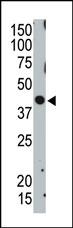
The anti-TSG101 Pab is used in Western blot to detect TSG101 in ZR75-1 cell lysate| Product Name | TSG101 Antibody (C-term) |
|---|---|
| Antibody Type | Primary Antibodies |
| Antigen Alias | TSG101; Tumor susceptibility gene 101 protein; ESCRT-I complex subunit TSG101 |
| Clonality | Polyclonal |
|---|---|
| Isotype | Ig |
| Host Species | Rabbit |
| Tested Applications | WB |
| WB:1:100~500 |
|
| Species Reactivity | Human |
| Concentration | 1mg/ml |
| Alternative Names | TSG101 Tumor susceptibility gene 101 protein ESCRT-I complex subunit TSG101 |
|---|---|
| Molecular Weight(MW) | 43944 Da |
| Function | Component of the ESCRT-I complex, a regulator of vesicular trafficking process. Binds to ubiquitinated cargo proteins and is required for the sorting of endocytic ubiquitinated cargos into multivesicular bodies (MVBs). Mediates the association between the ESCRT-0 and ESCRT-I complex. Required for completion of cytokinesis; the function requires CEP55. May be involved in cell growth and differentiation. Acts as a negative growth regulator. Involved in the budding of many viruses through an interaction with viral proteins that contain a late-budding motif P-[ST]-A-P. This interaction is essential for viral particle budding of numerous retroviruses |
| Tissue Specificity | Heart, brain, placenta, lung, liver, skeletal, kidney and pancreas |
| Cellular Localization | Cytoplasm. Membrane; Peripheral membrane protein. Nucleus. Late endosome membrane; Peripheral membrane protein. Note=Mainly cytoplasmic. Membrane-associated when active and soluble when inactive. Depending on the stage of the cell cycle, detected in the nucleus. Colocalized with CEP55 in the midbody during cytokinesis |
Application
The anti-TSG101 Pab is used in Western blot to detect TSG101 in ZR75-1 cell lysate| Application Notes | WB:1:100~500 |
|---|
| Form | Liquid |
|---|---|
| Storage Instructions | For short-term storage, store at 4° C. For long-term storage, aliquot and store at -20ºC or below. Avoid multiple freeze-thaw cycles. |
| Storage Buffer | Purified polyclonal antibody supplied in PBS with 0.09% (W/V) sodium azide. This antibody is purified through a protein G column, eluted with high and low pH buffers and neutralized immediately, followed by dialysis against PBS. |


