Application
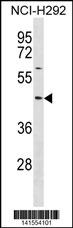
TXNIP Antibody (N-term) western blot analysis in NCI-H292 cell line lysates (35ug/lane).This demonstrates the TXNIP antibody detected the TXNIP protein (arrow).| Product Name | TXNIP(N-term) |
|---|---|
| Antibody Type | Primary Antibodies |
| Antigen Alias | TXNIP; VDUP1; Thioredoxin-interacting protein; Thioredoxin-binding protein 2; Vitamin D3 up-regulated protein 1 |
| Clonality | Polyclonal |
|---|---|
| Isotype | Ig |
| Host Species | Rabbit |
| Tested Applications | WB |
| WB:1:100~500 |
|
| Species Reactivity | Human |
| Concentration | 1mg/ml |
| Gene Synonyms | VDUP1 |
|---|---|
| Alternative Names | TXNIP VDUP1 Thioredoxin-interacting protein Thioredoxin-binding protein 2 Vitamin D3 up-regulated protein 1 |
| Molecular Weight(MW) | 43661 Da |
| Function | May act as an oxidative stress mediator by inhibiting thioredoxin activity or by limiting its bioavailability. Interacts with COPS5 and restores COPS5-induced suppression of CDKN1B stability, blocking the COPS5-mediated translocation of CDKN1B from the nucleus to the cytoplasm. Functions as a transcriptional repressor, possibly by acting as a bridge molecule between transcription factors and corepressor complexes, and over- expression will induce G0/G1 cell cycle arrest. Required for the maturation of natural killer cells. Acts as a suppressor of tumor cell growth. Inhibits the proteasomal degradation of DDIT4, and thereby contributes to the inhibition of the mammalian target of rapamycin complex 1 (mTORC1) |
| Tissue Specificity | This TXNIP antibody is generated from rabbits immunized with a KLH conjugated synthetic peptide between 1-30 amino acids from the N-terminal region of human TXNIP. |
| Cellular Localization | Cytoplasm (By similarity). |
| Entrez Gene | 10628 |
|---|---|
| Nucleotide Accession | NP_006463.3 |
Application
TXNIP Antibody (N-term) western blot analysis in NCI-H292 cell line lysates (35ug/lane).This demonstrates the TXNIP antibody detected the TXNIP protein (arrow).| Application Notes | WB:1:100~500 |
|---|
| Form | Liquid |
|---|---|
| Storage Instructions | For short-term storage, store at 4° C. For long-term storage, aliquot and store at -20ºC or below. Avoid multiple freeze-thaw cycles. |
| Storage Buffer | Purified polyclonal antibody supplied in PBS with 0.09% (W/V) sodium azide. This antibody is purified through a protein A column, followed by peptide affinity purification. |


