Application
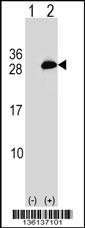
Western blot analysis of UBE2T (arrow) using rabbit polyclonal UBE2T Antibody (C-term) . 293 cell lysates (2 ug/lane) either nontransfected (Lane 1) or transiently transfected (Lane 2) with the UBE2T gene.| Product Name | UBE2T Antibody (C-term) |
|---|---|
| Antibody Type | Primary Antibodies |
| Antigen Alias | UBE2T; Ubiquitin-conjugating enzyme E2 T; Cell proliferation-inducing gene 50 protein; Ubiquitin carrier protein T; Ubiquitin-protein ligase T |
| Clonality | Polyclonal |
|---|---|
| Isotype | Ig |
| Host Species | Rabbit |
| Tested Applications | WB |
| WB:1:100~500 |
|
| Species Reactivity | Human |
| Concentration | 1mg/ml |
| Alternative Names | UBE2T Ubiquitin-conjugating enzyme E2 T Cell proliferation-inducing gene 50 protein Ubiquitin carrier protein T Ubiquitin-protein ligase T |
|---|---|
| Molecular Weight(MW) | 22521 Da |
| Function | Accepts ubiquitin from the E1 complex and catalyzes its covalent attachment to other proteins. Catalyzes monoubiquitination. Involved in mitomycin-C (MMC)-induced DNA repair: acts as a specific E2 ubiquitin-conjugating enzyme for the Fanconi anemia complex by associating with E3 ubiquitin-protein ligase FANCL and catalyzing monoubiquitination of FANCD2, a key step in the DNA damage pathway. Also mediates monoubiquitination of FANCL and FANCI. May contribute to ubiquitination and degradation of BRCA1. In vitro able to promote polyubiquitination using all 7 ubiquitin Lys residues, but may prefer 'Lys-11'-, 'Lys-27'-, 'Lys-48'- and 'Lys-63'-linked polyubiquitination |
| Tissue Specificity | This UBE2T antibody is generated from rabbits immunized with a KLH conjugated synthetic peptide between 125-154 amino acids from the C-terminal region of human UBE2T. |
| Cellular Localization | Nucleus. Note=Accumulates to chromatin. |
| Entrez Gene | 29089 |
|---|---|
| Nucleotide Accession | NP_054895.1 |
Application
Western blot analysis of UBE2T (arrow) using rabbit polyclonal UBE2T Antibody (C-term) . 293 cell lysates (2 ug/lane) either nontransfected (Lane 1) or transiently transfected (Lane 2) with the UBE2T gene.| Application Notes | WB:1:100~500 |
|---|
| Form | Liquid |
|---|---|
| Storage Instructions | For short-term storage, store at 4° C. For long-term storage, aliquot and store at -20ºC or below. Avoid multiple freeze-thaw cycles. |
| Storage Buffer | Purified polyclonal antibody supplied in PBS with 0.09% (W/V) sodium azide. This antibody is purified through a protein A column, followed by peptide affinity purification. |


